What if education could nurture not just academic excellence but also independence, creativity, and emotional intelligence? This is the promise of the Montessori philosophy, a revolutionary approach to learning that has reshaped classrooms around the globe. This educational method prioritizes the whole child, fostering growth in intellectual, social, and emotional domains.
At its core, the Montessori philosophy is built on respect for each child’s unique abilities and learning pace. In Montessori classrooms, children thrive in prepared environments designed to spark curiosity, encourage hands-on exploration, and develop lifelong skills. From mastering math with golden beads to building social skills through multi-age group collaboration, Montessori education emphasizes practical learning tailored to every stage of development.
In this article, we’ll delve into the key aspects of the Montessori philosophy, compare it to traditional education, and explore what science says about its transformative impact. Whether you’re a parent, educator, or curious learner, discover how this innovative approach can prepare children for a brighter, more adaptable future. Ready to dive into the world of Montessori? Let’s begin!
What is Montessori philosophy?
What if education could inspire children to embrace independence, creativity, and a lifelong love of learning? This is the heart of the Montessori philosophy, a revolutionary approach to education developed by Dr. Maria Montessori over a century ago. With its focus on holistic development, this method nurtures the whole child — physically, emotionally, socially, and intellectually.
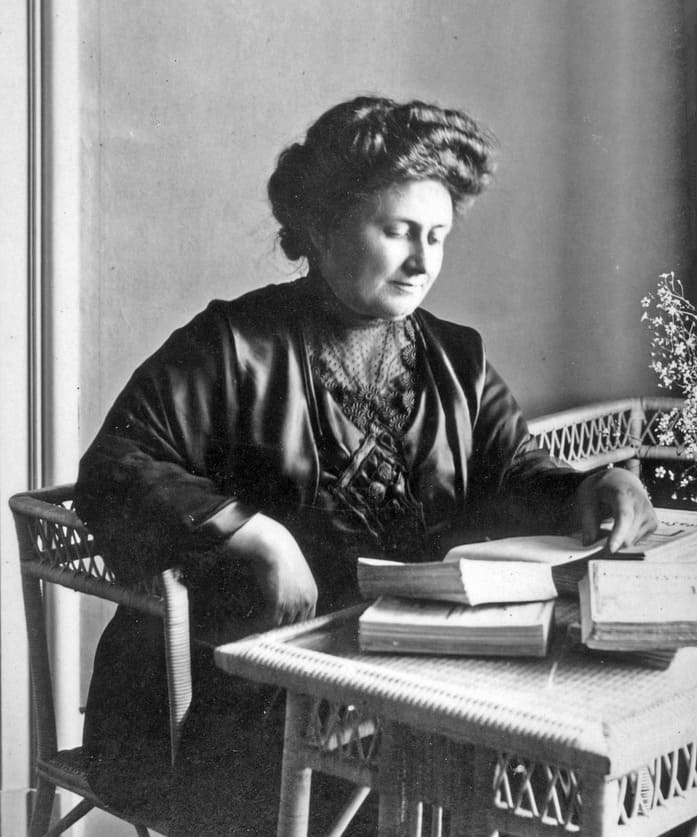
Dr. Montessori’s journey began with a simple yet profound question: How can we truly unlock a child’s potential? Her answer lay in observing how children naturally explore their surroundings when given the freedom and tools to do so. The Montessori philosophy was born from this insight, emphasizing a prepared environment where children learn at their own pace and cultivate skills like problem-solving, collaboration, and self-discipline.
But how has the Montessori method stood the test of time? We will explain below. From its beginnings in Italy to its global adoption, the philosophy has transformed classrooms into dynamic learning spaces across cultures and continents.
Today, Montessori schools are recognized for their ability to foster independence and curiosity while helping children develop practical life skills — a combination that aligns beautifully with the demands of modern education.
Does this sound like the kind of learning experience you wish you had? Imagine a classroom where every child feels valued, every material serves a purpose, and every activity encourages exploration. That’s the essence of Montessori philosophy — a model that’s not only an alternative to traditional schooling but a roadmap for creating confident, capable learners prepared to navigate the future. Let’s dive deeper into the key aspects, comparisons, and scientific insights that make the Montessori philosophy a cornerstone of progressive education.
Key aspects of Montessori philosophy
What makes the Montessori philosophy so unique? Its core principles are designed to create a learning environment that respects individuality while fostering growth and responsibility. Below, are the key aspects of the Montessori method that set it apart from traditional education approaches.
1. Child-centered learning
Have you ever noticed how children flourish when they’re given the freedom to follow their own interests? The Montessori philosophy places the child at the center of their learning journey, encouraging them to explore topics at their own pace and according to their preferences. Instead of enforcing rigid schedules, Montessori classrooms adapt to the child’s needs, creating a nurturing environment where curiosity thrives.
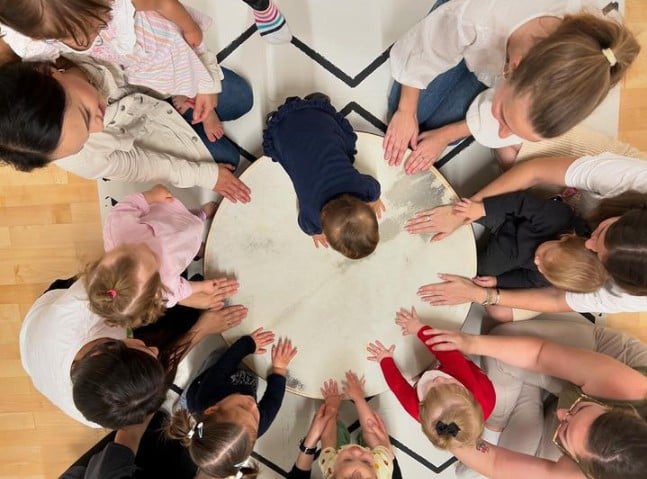
This approach empowers children to take charge of their education. They make choices, solve problems, and build confidence — all while developing a deep love of learning. Doesn’t that sound like the ideal classroom experience?
2. Respect for the child
According to the Montessori philosophy, respect is the foundation for fostering confidence, self-esteem, and a love of learning. This principle means recognizing every child as a capable individual with unique interests and abilities.
Montessori educators demonstrate respect by listening to children, giving them the freedom to make choices, and avoiding unnecessary interruptions during their activities. Even small gestures, like speaking at eye level or using kind and encouraging words, reinforce this value.
When children feel respected, they naturally reciprocate that respect — to their peers, their teachers, and their environment. It’s a vital skill for creating a society of empathetic, considerate individuals.
3. Absorbent mind
Dr. Maria Montessori described the early years of life as a period when the “absorbent mind” is at its peak. During this time, children take in information effortlessly from their surroundings, shaping their understanding of the world.
The Montessori method leverages this natural ability by providing environments rich in sensory and educational stimuli. For example, practical life activities like pouring water or arranging flowers not only build motor skills but also teach children about order and precision. Language and cultural activities are introduced early to take advantage of this remarkable capacity for absorption.

By nurturing the absorbent mind, Montessori classrooms lay the foundation for lifelong learning. Isn’t it incredible how much children can achieve when their natural tendencies are supported?
4. Prepared environments
A classroom could inspire independence and exploration at every turn. That’s the idea behind the carefully prepared environments central to the Montessori method. These spaces are organized with purpose: every material has a designated place, and every activity is designed to promote focus and self-direction.
Montessori environments are visually appealing and accessible, allowing children to move freely and select activities that pique their interest. This structured freedom encourages them to engage deeply with their tasks, building both confidence and discipline.
5. Hands-on learning
Do you learn best by doing? Montessori students do too! Hands-on learning is a cornerstone of the Montessori philosophy. Specialized materials, such as the iconic pink tower or movable alphabet, help children develop practical skills and critical thinking through active engagement.
These tools are designed to be self-correcting, meaning children can identify and fix their mistakes independently. This not only enhances their understanding but also fosters a sense of accomplishment. Isn’t that the kind of skill-building every child deserves?
6. Intrinsic motivation
Wouldn’t it be wonderful if children learned for the sheer joy of it? The Montessori method nurtures intrinsic motivation by focusing on internal rewards rather than external validation. Instead of relying on grades or prizes, children find satisfaction in mastering new skills and completing challenges.
By prioritizing personal growth and achievement, the Montessori philosophy encourages lifelong learners who are driven by curiosity and passion rather than fear of failure or the need for approval.
7. Multi-age classrooms
Have you ever seen older children teaching younger ones? In Montessori classrooms, this happens every day. Multi-age groups are a hallmark of the Montessori method, allowing children to learn from one another in a collaborative environment.

Older students act as mentors, reinforcing their own knowledge by teaching younger peers. Meanwhile, younger children benefit from observing advanced skills and gaining confidence in their own abilities. This dynamic builds a strong sense of community and cooperation, preparing children for real-world social interactions.
8. Development of independence and responsibility
The Montessori philosophy emphasizes independence and responsibility from an early age. Students are encouraged to manage their tasks, care for their environment, and make decisions about their learning.
Whether it’s pouring water, tidying up materials, or choosing which activity to focus on, children take ownership of their actions. These experiences instill a sense of accountability and self-reliance that extends beyond the classroom.
9. Freedom within limits
What does true freedom look like in a Montessori classroom? It’s not about chaos or unrestricted liberty; it’s about structured freedom that empowers children to make choices within clear and consistent boundaries. The Montessori philosophy recognizes that children thrive when they can explore their interests while still understanding the limits that guide their behavior.
In practice, this principle allows children to select activities that intrigue them, fostering a sense of ownership and motivation. At the same time, they learn self-discipline by respecting the rules of the classroom, such as taking turns, cleaning up after themselves, or waiting patiently for a peer to finish using a material.
By balancing freedom with responsibility, Montessori classrooms create an environment where children learn independence without losing sight of how their actions impact others. Isn’t this the kind of balance every parent hopes to see in their child’s growth?
10. Observation
Observation is a cornerstone of the Montessori philosophy, enabling teachers to understand each child’s unique needs and interests. Rather than intervening unnecessarily, Montessori educators act as guides, observing how children interact with their environment and materials.
This principle ensures that lessons and activities are tailored to a child’s developmental stage. For example, if a Montessori teacher notices a child gravitating toward activities involving counting, they might introduce materials that build on that interest, such as the number rods or spindle box.
Observation also helps educators identify sensitive periods — times when a child is especially receptive to learning a specific skill — and adjust their guidance accordingly.
From fostering independence to creating a collaborative community, the Montessori philosophy introduces a truly transformative approach to education. Which of these principles do you find most inspiring? Together, they create a framework that not only prepares children for academic success but also equips them with essential life skills.
Montessori philosophy vs. traditional education
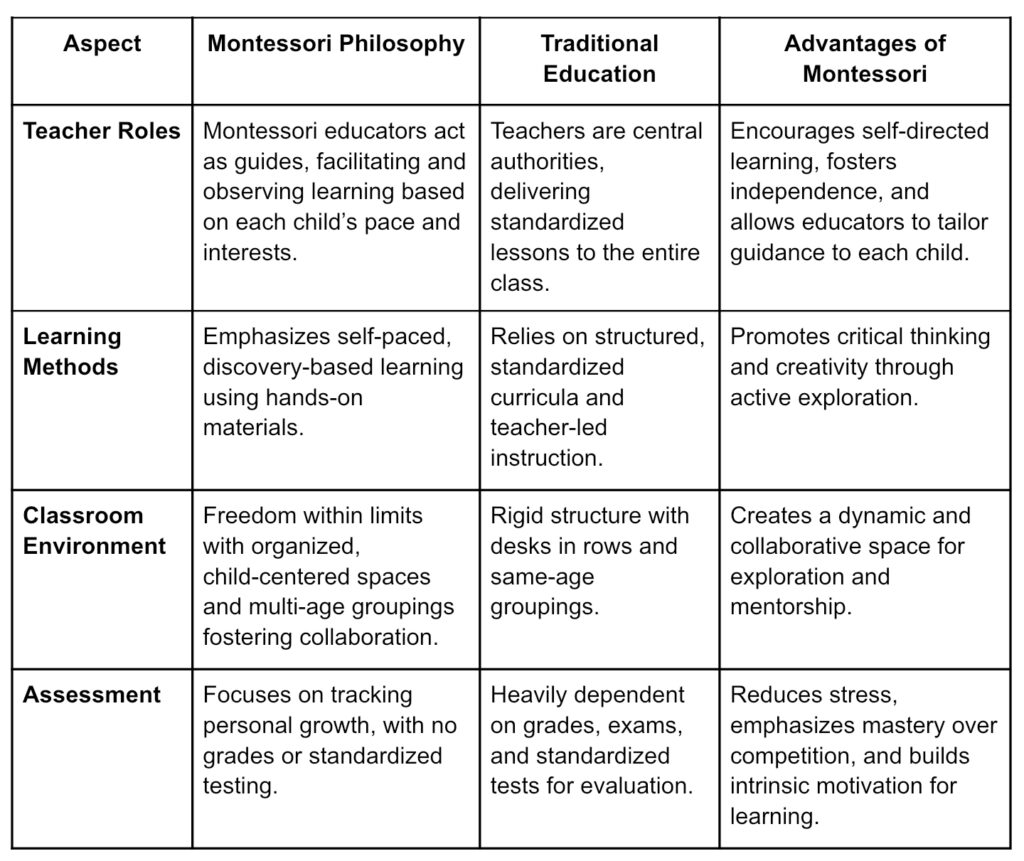
Below, we explain how the Montessori philosophy stands out compared to traditional education. By focusing on individuality, intrinsic motivation, and a prepared environment, it offers an alternative that prioritizes the holistic development of each child. Let’s look at the core pillars of the two systems and the advantages the Montessori method brings into the game.
1. Teacher roles: guides vs. instructors
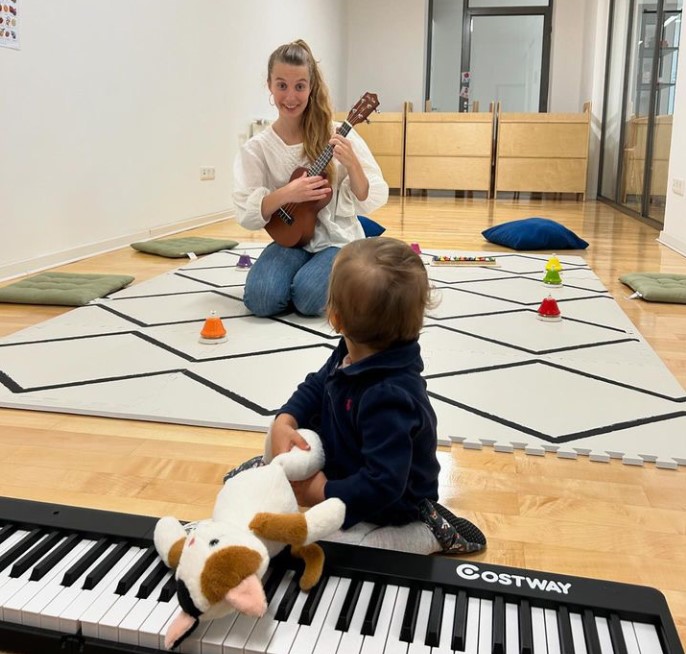
Can you imagine a classroom where the teacher is not the center of attention but rather a guide? In the Montessori philosophy, educators observe children’s interests and needs, providing resources and gentle guidance to support self-directed learning. For instance, if a child shows interest in numbers, the teacher might introduce hands-on tools like the golden beads to deepen their understanding.
In traditional education, teachers often follow a set curriculum, delivering lessons to the entire class and expecting uniform results. While this approach ensures consistency, it may overlook individual learning styles. Montessori’s approach, on the other hand, empowers children to take charge of their education, fostering independence and confidence.
2. Learning methods: Self-paced exploration vs. standardized curricula
Do all children learn at the same speed? Of course not! Montessori classrooms embrace this diversity by allowing children to learn at their own pace. Hands-on materials, like the movable alphabet or geography puzzles, engage children in discovery-based learning, making concepts tangible and memorable.
Traditional education often relies on teacher-led instruction and a one-size-fits-all curriculum. This can leave some children bored and others struggling to keep up. Montessori’s flexible approach ensures that each child is challenged appropriately, cultivating a genuine love of learning.
3. Classroom environment: Freedom vs. rigidity
What if a classroom could inspire creativity instead of enforcing conformity? Montessori classrooms are designed to encourage independence, with child-sized furniture, open shelves, and multi-age groupings. Children can move freely, select activities, and work collaboratively or individually as they choose.
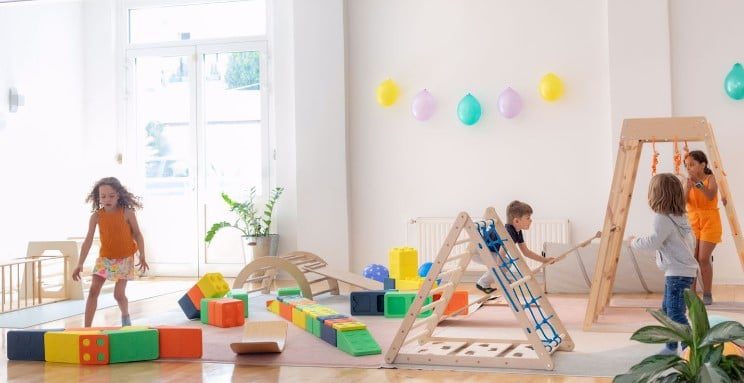
Traditional classrooms, on the other hand, often follow a more rigid setup, with children seated in rows and expected to focus on teacher-led instruction. While this can instill discipline, it may stifle creativity and exploration. Montessori’s freedom within limits allows children to thrive in an environment tailored to their developmental needs.
4. Assessment: Growth vs. grades
Does a grade truly measure a child’s potential? Montessori schools emphasize progress tracking and personal growth over grades or exams. Teachers keep detailed records of each child’s achievements, providing insights into their development without the pressure of competition.
Traditional education often prioritizes grades and standardized tests as measures of success. While these metrics provide benchmarks, they can create undue stress and discourage risk-taking. Montessori’s focus on intrinsic motivation helps children find joy in learning and develop resilience.
The comparison to traditional education highlights the unique strengths of the Montessori philosophy. By nurturing independence, fostering creativity, and respecting individuality, Montessori classrooms prepare children not just for academic success but for a lifetime of curiosity and confidence.
Isn’t this the kind of education every child deserves? Whether you’re a parent, teacher, or curious learner, exploring the Montessori method could be the first step toward a brighter, more fulfilling future for the next generation.
Evidence-based perspective on the Montessori philosophy
The Montessori philosophy has been extensively studied, with research consistently highlighting its profound benefits. Here’s an in-depth look at ten key studies and their findings.
- Superior Academic Performance
- Study: Lillard, A.S., & Else-Quest, N. (2006). The Early Years: Evaluating Montessori Education
- Outcome: This study compared Montessori and traditional kindergarten programs, finding that Montessori students significantly outperformed their peers in reading and math. Beyond academics, they also showed better social problem-solving skills, such as resolving conflicts collaboratively.
- Explanation: The Montessori philosophy’s focus on individualized, hands-on learning allows children to grasp abstract concepts through tangible experiences. For instance, tools like the golden beads for math provide a deep, practical understanding of numerical relationships, fostering both comprehension and enjoyment of learning.
- Key Insight: By prioritizing meaningful engagement over rote memorization, Montessori education helps children excel academically while building critical interpersonal skills.
- Social and Emotional Regulation
- Study: Lillard, A.S. (2012). Preschool Children’s Development in Classic Montessori, Supplemented Montessori, and Conventional Programs
- Outcome: Children in classic Montessori classrooms displayed superior emotional regulation, including patience, empathy, and the ability to manage frustration. These traits were notably weaker in children from traditional programs.
- Explanation: Montessori classrooms encourage peaceful conflict resolution and respect for others. Practices such as “grace and courtesy lessons” teach children how to interact with kindness and resolve disputes calmly, creating a harmonious social environment.
- Key Insight: By embedding respect and collaboration into daily routines, Montessori education fosters emotionally intelligent individuals equipped to navigate complex social dynamics.
- Increased Creativity and Engagement
- Study: Rathunde, K., & Csikszentmihalyi, M. (2005). Middle School Students’ Motivation and Quality of Experience: A Comparison of Montessori and Traditional School Environments
- Outcome: Montessori students exhibited higher levels of engagement and creative thinking in comparison to peers in traditional schools. They also reported finding their tasks more enjoyable and meaningful.
- Explanation: Montessori’s emphasis on self-paced, interest-driven exploration allows children to approach tasks with genuine curiosity. Activities like creating art projects or building models foster creativity by giving students the freedom to interpret and express ideas in their own way.
- Key Insight: Montessori’s approach to learning cultivates intrinsic motivation and creativity, enabling students to develop innovative thinking skills essential for the modern world.
- Executive Function and Long-Term Success
- Study: Dohrmann, K.R., et al. (2007). Outcomes for Students in a Montessori Program: A Longitudinal Study of the Experience in Milwaukee Public Schools
- Outcome: This longitudinal study found that Montessori students exhibited stronger executive function skills, such as time management, adaptability, and independence, throughout their academic careers and into adulthood.
- Explanation: Montessori classrooms are designed to promote independence from an early age. Children manage their own schedules, choose activities, and work towards goals, which strengthens their ability to self-regulate and plan.
- Key Insight: Montessori’s emphasis on self-directed learning equips children with the skills necessary for both academic and professional success.
- Literacy and Numeracy Gains
- Study: Ansari, A., & Winsler, A. (2014). Montessori Education and Socioeconomic Diversity
- Outcome: Children from low-income families in Montessori programs showed significant improvement in literacy and numeracy skills compared to peers in traditional schools.
- Explanation: Montessori materials, such as the movable alphabet for reading and number rods for math, make abstract concepts accessible and engaging. These tools allow children to develop a strong foundation in essential academic skills regardless of their background.
- Key Insight: Montessori’s inclusive approach ensures that all children, regardless of socioeconomic status, receive the resources they need to thrive academically.
- Improved Critical Thinking
- Study: Lillard, A.S. (2017). Montessori Preschool Elevates and Equalizes Child Outcomes: A Longitudinal Study
- Outcome: Montessori-educated children displayed superior critical thinking skills, excelling at tasks requiring analysis, reasoning, and problem-solving.
- Explanation: Montessori’s discovery-based learning approach encourages children to ask questions and seek solutions independently. For example, science experiments or geography puzzles challenge students to think critically about cause and effect.
- Key Insight: By fostering inquiry and exploration, Montessori education equips children with the cognitive tools necessary for lifelong learning.
- Early Cognitive Advantages
- Study: Esposito, L., & Baroody, A. (2017). Effects of Montessori Education on Early Cognitive Development
- Outcome: Montessori children demonstrated advanced cognitive skills, including enhanced attention control, working memory, and reasoning, during their early years.
- Explanation: The Montessori philosophy capitalizes on the “absorbent mind” stage of early childhood, providing a rich environment filled with sensory materials and practical life activities that stimulate cognitive development.
- Key Insight: Montessori education maximizes the critical early years of brain development, laying a strong foundation for future success.
- Emotional Well-Being
- Study: Brown, K.H., & Vaughn, B.E. (2015). Emotional Benefits of Montessori Education
- Outcome: Montessori students reported higher levels of emotional well-being and lower levels of stress compared to their peers in traditional schools.
- Explanation: Montessori classrooms focus on creating calm, peaceful environments where children feel safe and valued. Practices such as uninterrupted work periods and mindfulness activities contribute to reduced stress and increased emotional stability.
- Key Insight: Montessori’s nurturing approach supports not just academic growth but also the emotional health of every child.
- Social Equity in Education
- Study: Miller, S. (2019). The Role of Montessori Education in Promoting Equity
- Outcome: This study found that Montessori classrooms reduced disparities in academic achievement between children from different demographic groups, promoting social equity.
- Explanation: Montessori’s individualized approach ensures that every child receives the guidance and resources they need to succeed, regardless of their starting point.
- Key Insight: Montessori education is a powerful tool for creating equitable opportunities in diverse classrooms.
- Lifelong Academic and Personal Success
- Study: Gutek, G.L., & Gutek, P.A. (2016). Montessori Education and Long-Term Outcomes
- Outcome: Montessori graduates reported higher career satisfaction, stronger critical thinking skills, and greater adaptability in adulthood compared to peers from traditional schools.
- Explanation: Montessori’s focus on holistic development instills confidence, creativity, and a passion for lifelong learning, which carry over into professional and personal spheres.
- Key Insight: Montessori education prepares students not only for academic success but also for fulfilling, impactful lives.
These ten studies illustrate the profound impact of the Montessori philosophy on children’s development. From fostering creativity and critical thinking to promoting emotional resilience and social equity, Montessori education offers a transformative approach to learning that benefits students far beyond the classroom.
Are you ready to explore how Montessori principles can shape a better future for education? The evidence is clear—Montessori works.
Criticisms and misconceptions about Montessori philosophy
Have you ever heard someone dismiss the Montessori philosophy as unstructured or elitist? Like any educational approach, Montessori has its share of misconceptions and critiques. Let’s address these concerns, clarify misunderstandings, and uncover why Montessori remains a powerful choice for nurturing young minds.
1. Lack of structure and discipline
Is Montessori really a free-for-all where children do whatever they want? This is one of the most common misconceptions about the Montessori philosophy. Critics often assume that its emphasis on freedom means there’s no structure or discipline.
The reality couldn’t be further from the truth. Montessori classrooms operate on the principle of freedom within limits. While children are free to choose activities that interest them, they must also follow guidelines that teach responsibility and respect. For example, a child can work with a specific material for as long as they wish, but they are also expected to return it to its designated spot for others to use.
Discipline in Montessori isn’t imposed; it’s cultivated from within. By giving children ownership of their learning and environment, the Montessori philosophy fosters self-discipline and accountability. Isn’t that the kind of discipline every parent wants for their child — one rooted in intrinsic motivation rather than external enforcement?
2. Misunderstanding the “free-range” nature of learning
Does Montessori education let children run wild with no direction? This myth often arises from the philosophy’s child-centered approach. While it’s true that Montessori students have the freedom to choose their activities, this freedom is carefully guided by the teacher and the prepared environment.
Montessori educators are trained to observe each child and introduce new challenges when they’re ready. The classroom is meticulously organized with materials designed to teach specific skills, ensuring that children’s choices lead to meaningful learning.
Imagine a child independently choosing to work with counting beads. While this may seem like play, they are actually mastering concepts like quantity and sequence. Doesn’t that sound like the perfect blend of freedom and purposeful learning?
3. Accessibility and affordability
Is Montessori education only for wealthy families? Accessibility and affordability are valid concerns. Private Montessori schools can be expensive, which often leads to the misconception that the philosophy is elitist or exclusive.
However, there’s good news. Public Montessori programs are on the rise, making this educational approach more accessible to families from diverse socioeconomic backgrounds. Additionally, many private Montessori schools offer scholarships or sliding-scale tuition to ensure that more children can benefit from this unique method.
Parents can also incorporate Montessori principles at home using free or affordable resources. Simple practices like organizing toys on low shelves or encouraging independence in daily routines can make a big difference. Isn’t it inspiring to know that Montessori’s benefits can extend beyond the classroom?
Addressing the balance
Every educational philosophy has its challenges, and Montessori is no exception. However, many of the criticisms stem from misunderstandings or incomplete information. By balancing freedom with structure, providing guided learning, and expanding accessibility, Montessori continues to prove itself as a thoughtful, effective approach to education.
What do you think — are these concerns enough to outweigh the proven benefits of the Montessori philosophy? For many families, the answer is a resounding no. With a little research and creativity, Montessori education can be a powerful tool for every child, regardless of background.
Would you like to learn more about how Montessori could fit into your child’s life? The answers might surprise you!
Final words: Why Montessori philosophy matters
Armed with the Montessori philosophy, education can empower children to grow into independent thinkers, compassionate individuals, and lifelong learners. Throughout this article, we’ve explored the evidence-based benefits of Montessori education, from its ability to enhance cognitive skills and creativity to its focus on emotional well-being and social equity. By emphasizing hands-on learning, intrinsic motivation, and respect for the individual child, the Montessori method creates an environment where children can truly thrive. But why does Montessori matter for the future of education?
As our world evolves, traditional methods often struggle to keep up with the need for critical thinkers and adaptable problem-solvers. Montessori classrooms, on the other hand, are designed to meet these challenges head-on. They cultivate not just academic excellence but also the independence, resilience, and empathy needed to navigate an ever-changing world.
Imagine an environment where every child feels valued, where learning is driven by curiosity, and where education prepares them for both academic and life success. That’s the power of the Montessori philosophy. It’s more than a method — it’s a movement toward a brighter future for the next generation.
If you’re ready to take the next step, we invite you to explore the Montessori Family Center. Discover how the Montessori philosophy can benefit your child, and learn about our wide range of courses and activities designed for children and parents alike.
Visit us today to find out how Montessori education can transform the way your family experiences learning. Together, let’s nurture the next generation of thinkers, creators, and leaders!
FAQ: Understanding the Montessori philosophy
1. What is the Montessori philosophy?
The Montessori philosophy is an educational approach developed by Dr. Maria Montessori that focuses on nurturing the whole child academically, socially, and emotionally. It emphasizes self-directed learning, hands-on activities, and a prepared environment that fosters independence, creativity, and critical thinking.
2. Who developed the Montessori philosophy?
Dr. Maria Montessori, the first female physician in Italy, pioneered this philosophy in the early 20th century. As a groundbreaking medical doctor and educator, she used her scientific expertise to study child development, focusing on how the brain grows and learns. Her methods were rooted in careful observation of children’s natural behaviors and interests, leading to the creation of an educational approach that prioritizes independence, hands-on learning, and respect for each child’s unique potential.
3. How does Montessori philosophy differ from traditional education?
Montessori emphasizes individualized learning, freedom within limits, and hands-on exploration, whereas traditional education often relies on teacher-led instruction and standardized curricula. Montessori classrooms also feature multi-age groupings, encouraging collaboration and mentorship.
4. What are the key principles of Montessori philosophy?
Core principles include child-centered learning, prepared environments, hands-on activities, intrinsic motivation, multi-age classrooms, and fostering independence and responsibility. These elements work together to support holistic child development.
5. Is Montessori education only for preschool children?
While Montessori is well-known for its preschool programs, it’s a lifelong approach that extends to elementary, middle, and even high school levels. The philosophy adapts to each developmental stage, providing age-appropriate learning opportunities.
6. Does Montessori education lack structure?
No, Montessori classrooms follow the principle of “freedom within limits.” While children can choose activities that interest them, they must work within a structured environment designed to encourage discipline, focus, and respect for others.
7. What does a Montessori classroom look like?
Montessori classrooms are carefully organized and child-centered, featuring open shelves with materials designed for self-directed learning. They include areas for practical life skills, math, language, science, and arts, creating a dynamic space for exploration.
8. Is Montessori education effective?
Research shows that Montessori education enhances cognitive skills, creativity, and social-emotional development. Studies also highlight improved academic performance, critical thinking, and intrinsic motivation among Montessori students compared to their peers in traditional settings.
9. Can Montessori principles be applied at home?
Absolutely! Parents can incorporate Montessori principles by creating a prepared environment at home, encouraging independence, and introducing hands-on activities. Simple practices like organizing toys on low shelves or involving children in daily chores align with the Montessori method.
10. How can I learn more about the Montessori philosophy?
To explore the Montessori philosophy further, visit a local Montessori school, attend workshops, or explore resources like our Montessori Family Center. Our center offers courses and activities for children and parents, helping you bring the benefits of Montessori into your life.
References and further reading
Explore these valuable resources for a deeper understanding of the Montessori philosophy and its impact on education:
- What is Montessori Philosophy? – Montessori.org. This comprehensive guide introduces the Montessori philosophy, its origins, and key principles, emphasizing its focus on fostering independence and holistic development.
- Montessori Philosophy Overview – River Montessori Charter. A detailed overview of Montessori education, explaining how prepared environments and child-centered learning enhance development across multiple domains.
- Montessori vs. Mainstream Education – AMI USA. This comparison highlights the key differences between Montessori and traditional educational models, focusing on their approaches to learning, teaching, and assessment.
- What the Evidence Says About Montessori Education – Psychology Today. A research-backed article examining the cognitive and social benefits of Montessori education, supported by studies and expert insights.
- Montessori Education’s Academic and Social Benefits – Nature.com. This peer-reviewed study explores how Montessori classrooms enhance academic performance, critical thinking, and collaboration among students.
- Montessori Research and Data – American Montessori Society. A collection of research and data demonstrating the effectiveness of Montessori education, including studies on long-term outcomes.
- Research Behind Montessori Schools – Psychology Today. An accessible explanation of how Montessori methods align with developmental science to support cognitive and emotional growth.
- What Research Tells Us About Montessori – Montessori.org. An insightful article on the evidence supporting Montessori’s effectiveness, highlighting its transformative impact on children’s learning.
- Scientific Perspectives on Montessori Education – ScienceDirect. A systematic review of Montessori education, examining its implementation and outcomes across diverse settings.
- Montessori Philosophy Explained. A video breakdown of the Montessori philosophy, featuring visuals of classrooms and insights into its unique approach to learning.
These resources provide a wealth of information on the Montessori philosophy, offering both research-backed perspectives and practical insights for parents, educators, and anyone interested in this transformative educational approach.