
In this article, we’ll explore the real benefits of Montessori education, backed by research, experience, and insights from passionate educators. If you’re wondering whether Montessori is the right path for your child, let’s uncover why it just might be the smartest step you can take.
Montessori education has been around for over a century — yet it’s more relevant today than ever before. With parents and educators seeking meaningful, child-centered alternatives to traditional learning, Montessori classrooms are gaining attention worldwide. But what exactly makes this approach so effective? And how does it support your child’s development? Let’s find out!
What is Montessori education?
Montessori education is more than a teaching method — it’s a philosophy that honors each child’s natural curiosity and desire to learn. Developed by Dr. Maria Montessori over 100 years ago, this approach incorporates the belief that children thrive when older people respect them as individuals and give them the freedom to explore at their own pace.
Instead of forcing memorization or rigid lessons, Montessori classrooms encourage hands-on learning, movement, and independence. The result? Numerous benefits of Montessori education, such as the ability to experience and understand knowledge instead of simply absorbing it. Children learn to think critically, solve problems creatively, and develop lifelong skills that serve them far beyond the classroom.
Montessori environments support self-directed learning with carefully chosen materials and activities that match a child’s developmental stage. Teachers act more as guides than traditional instructors, creating a space where children lead their own learning journeys.
Curious how this unique method connects to real-world results? The benefits of Montessori education extend far beyond early childhood. Let’s break them down!
The benefits of Montessori education explained
As you can see, the Montessori curriculum isn’t just an alternative — it’s a powerful framework for helping children thrive. But what exactly makes it so effective?
The benefits of Montessori education are wide-ranging and well-documented, especially when it comes to early childhood development. Here’s what sets Montessori apart:
- Stronger cognitive development and academic achievement through hands-on, self-paced learning;
- Enhanced social and emotional skills like empathy, collaboration, and self-regulation;
- Greater independence and responsibility built through daily decision-making and real-life tasks;
- Increased creativity and curiosity thanks to freedom within structure;
- Lifelong learning habits developed through intrinsic motivation rather than external rewards;
- Proven long-term success, with many studies linking Montessori to better outcomes well into adolescence and adulthood.
Each of these benefits plays a role in shaping confident, capable, and curious individuals. Let’s take a closer look at how Montessori supports your child’s growth.
Cognitive development and academic advantages
One of the most widely recognized benefits of Montessori education is its strong, research-backed influence on cognitive development and academic performance. But what exactly makes Montessori so effective when it comes to how children learn and grow intellectually?
Montessori classrooms emphasize active, hands-on learning where children engage with materials designed to build critical thinking, logic, and problem-solving skills. Instead of being told what to learn, students discover concepts through exploration — a process that deepens understanding and retention.
A 2024 comparative study by Hamid and Ozdemir found that children educated under the Montessori method demonstrated significantly higher cognitive development and academic achievement than those in traditional education systems. The study attributes this to the Montessori environment’s focus on independence, self-paced learning, and multi-sensory activities.
These outcomes are not accidental. Montessori’s unique structure — combining freedom of choice with carefully prepared learning materials — enhances concentration, memory, and intrinsic motivation. Students do not just prepare for the next test — they prepare for the next challenge.
Social and emotional development
The benefits of Montessori education extend far beyond academics — they reach the heart of how children interact with others, understand themselves, and build lasting emotional resilience.
From the moment a child enters a Montessori environment, they face respect, patience, and trust. These are not just classroom values — they are daily experiences that shape a child’s emotional world. Montessori classrooms are intentionally designed to nurture empathy, self-confidence, and emotional regulation.
Children learn to manage their feelings through choice, responsibility, and calm routines. Conflicts are resolved through peaceful communication, not punishment. Group activities encourage cooperation instead of competition. The result? A safe, supportive space where emotional intelligence grows alongside academic skill.
A 2024 study conducted on Montessori preschools in Washington confirmed these outcomes. It found that children enrolled in Montessori programs showed significant short-term improvements in emotional development, particularly in self-regulation, empathy, and social behavior, compared to children in non-Montessori settings.
Students develop a strong sense of respect, not just for others, but for themselves and their environment. As Rasmussen University notes, Montessori students often transition into traditional environments with advanced communication and self-control skills that give them a lasting advantage.
So, what are the benefits of a Montessori school when it comes to emotional development? Children become more patient, more mindful, and more compassionate — skills that shape not only better students but better people.
Independence and life skills
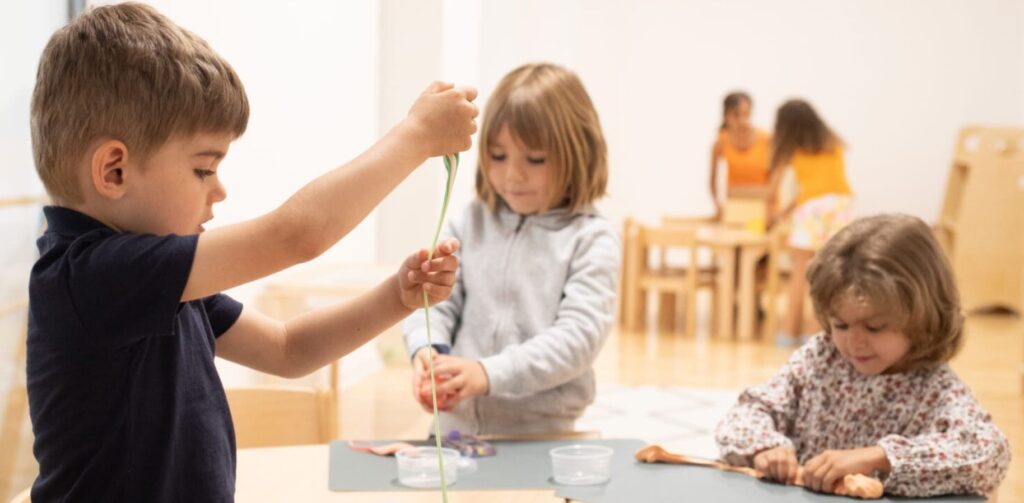
Have you ever seen a toddler pour their own drink, tie their shoes, or calmly clean up after themselves, without being told? That’s not magic. That’s Montessori. One of the most practical and powerful benefits of Montessori education is its deep commitment to helping children become independent, capable individuals from the very start.
In a Montessori classroom, even the youngest learners get real tasks — pouring, sweeping, dressing, caring for plants, and more. These practical life activities do more than keep kids busy. They build focus, fine motor skills, self-control, and most importantly, confidence.
This intentional design is no accident. Giving children age-appropriate responsibility helps them take ownership of their actions and decisions, laying the foundation for lifelong self-discipline and motivation.
Scientific research supports this, too. A 2023 case study on Montessori pedagogy at PAUD Montessori Futura Indonesia found that Montessori methods significantly increased independent learning in early childhood. The study highlighted how prepared environments, teacher roles as guides, and freedom of choice contributed to young children developing the ability to manage their own time and tasks effectively.
Fostering independence is not just about academic growth — it’s about preparing children for real life. Children who learn to do things for themselves become more confident, resourceful, and resilient in the face of challenges.
When people ask about Montessori benefits, this one’s a standout: your child isn’t just learning how to spell or count — they’re learning how to navigate the world with confidence, competence, and care.
Creativity and innovation
Is creativity something we’re born with or something we build? In Montessori education, it’s both. One of the less talked-about yet incredibly powerful Montessori education benefits is how it nurtures not only knowledge but also imagination.
Montessori classrooms are filled with opportunities for children to think differently. Instead of being told what to do and how to do it, children are encouraged to choose their work, explore open-ended questions, and experiment freely with materials. This space for self-expression naturally fuels curiosity, problem-solving, and innovation.
But does this freedom actually translate into real creative ability? Research says yes.
A 2018 presentation at the AMS Conference explores how Montessori students scored higher on originality and flexibility in creative thinking compared to their peers in traditional education models. It emphasizes how uninterrupted work time, intrinsic motivation, and mixed-age classrooms support the development of divergent thinking.
In another peer-reviewed study, researchers found a positive correlation between long-term exposure to Montessori environments and higher levels of creative performance in children, especially in tasks requiring originality and elaboration.
These findings support what many Montessori educators witness daily: children come up with unique ideas, unexpected solutions, and imaginative interpretations — not because they’re told to, but because they’re empowered to think freely.
Let’s summarize. What are the benefits of Montessori education when it comes to creativity? It’s about more than just drawing or painting — it’s about developing a mindset that embraces challenges, explores possibilities, and confidently invents something new. Below, you will find a long list of benefits associated with the Montessori system.
Expanded list of Montessori education benefits
Whether you’re looking for academic excellence, emotional intelligence, or lifelong practical skills, the benefits of Montessori education are both broad and deep. Here’s a comprehensive list of 50 proven benefits that show why this child-centered approach has stood the test of time:
- Self-paced learning – Children advance through concepts when they’re ready, reducing stress and increasing mastery.
- Independence – Students manage their tasks, materials, and time, growing into capable, self-directed individuals.
- Intrinsic motivation – Learning is driven by curiosity, not rewards or grades.
- Critical thinking – Montessori nurtures problem-solvers who can analyze and evaluate instead of just memorizing.
- Hands-on exploration – Specially designed materials help children discover abstract ideas through tactile experience.
- Improved concentration – Extended, uninterrupted work periods train focus and attention span.
- Emotional regulation – Calm environments and personal responsibility foster self-control and mindfulness.
- Respect for others – Children practice empathy, listening, and mutual respect in mixed-age classrooms.
- Real-world readiness – Activities like cooking, cleaning, and organizing build real-life competence.
- Academic strength – Montessori students often outperform peers in math, language, and science.
- Choice within limits – Structured freedom helps children learn decision-making and accountability.
- Love of learning – Children develop a joyful relationship with education that lasts a lifetime.
- Confidence and self-esteem – Achievements through self-effort boost pride and self-belief.
- Time management – Children learn to plan their day, meet goals, and manage transitions independently.
- Adaptability – Open-ended learning supports flexible thinking and a growth mindset.
- Peaceful conflict resolution – Children are taught how to communicate needs and solve problems calmly.
- Leadership skills – Older students take on mentoring roles, building responsibility and empathy.
- Purposeful learning – All activities are meaningful, supporting deep engagement and motivation.
- Physical coordination – Montessori integrates movement into learning, improving motor development.
- Cultural awareness – Children explore geography, global traditions, and diversity early on.
- Environmental stewardship – Respect for nature and sustainability is built into classroom practices.
- Creative expression – Art, music, storytelling, and open-ended tasks inspire innovation.
- Fewer behavioral issues – Choice, calmness, and intrinsic motivation reduce discipline problems.
- Guidance over control – Teachers guide instead of lecture, nurturing curiosity and confidence.
- Peer learning – Multi-age classrooms allow students to learn from and support one another.
- Resilience – Montessori encourages trial, error, and perseverance without fear of failure.
- Calm, orderly spaces – Montessori environments promote emotional peace and mental clarity.
- Personalized feedback – Teachers observe closely and give targeted, constructive feedback.
- Responsibility – Children care for their environment, belongings, and even classroom pets or plants.
- Initiative – Children choose their work and take pride in completing it with minimal adult direction.
- Curiosity-driven projects – Montessori encourages deep dives into topics that truly interest the child.
- Executive functioning – Planning, organizing, and decision-making are practiced daily.
- Real-world problem-solving – Activities like budgeting, measuring, and sequencing teach life math and logic.
- Social maturity – Children regularly collaborate with both younger and older peers.
- Compassion – Community values like kindness and inclusion are modeled and reinforced.
- Healthy risk-taking – Montessori gives space for trial and discovery, not fear of making mistakes.
- Language development – Montessori materials help build vocabulary, grammar, reading, and communication skills naturally.
- Mathematical reasoning – Math is taught through tangible materials that make abstract concepts visible and logical.
- Scientific thinking – Observation, experimentation, and classification are taught through discovery-based learning.
- Global thinking – Children explore the interconnectedness of people, places, and ecosystems.
- Self-correction – Montessori materials include built-in feedback, encouraging independent problem-solving.
- Order and logic – Classrooms are designed to reinforce sequences, categorization, and spatial awareness.
- Freedom of movement – Children are free to move and work where they feel most focused and productive.
- Respect for process – Children learn that mastery comes through repetition and reflection.
- Joy in effort – Work is seen as a satisfying challenge, not a burden.
- Early ethical development – Concepts like fairness, truth, and responsibility are discussed early.
- Internal discipline – Without external punishments or rewards, children build self-regulation from within.
- Emotional intelligence – Children practice naming feelings, setting boundaries, and understanding others.
- Educational equity – Montessori supports diverse learners, including those with special needs, through individualized attention.
- Lifelong impact – Montessori education helps shape independent, curious, and capable individuals who thrive long after graduation.
The benefits of Montessori for early childhood development
Rather than accelerating academics, Montessori prioritizes natural development, offering meaningful materials and routines that match a child’s stage of growth. It supports key milestones in fine motor skills, sensory play, crawling, and early literacy, and these are the benefits children get from these practices:
- Fine motor skills. Fine motor development is foundational to everything from grasping a spoon to holding a pencil. Learn how to set up activities that match a child’s current abilities, such as threading, stacking, and pouring, while avoiding adult overcorrection: Developing fine motor skills in children aged 0–3 years.
- Sensory play. In Montessori, sensory experiences are more than just fun — they are essential. Discover how hands-on, multi-sensory activities stimulate brain development and support self-regulation: The role of sensory play in early childhood development and Montessori education.
- Crawling stage. Crawling is often overlooked in favor of walking — but in Montessori, it’s a vital developmental milestone. Find out how it helps children strengthen muscles, develop spatial awareness, and build confidence: Montessori approach for the crawling stage and essential guide to crawling.
- Early literacy. Reading doesn’t begin with the alphabet. It begins with listening, speaking, and bonding. In this article on early literacy, we explain how Montessori supports language development from the earliest days of life.
Long-term Montessori school benefits and success stories
What happens after Montessori? Do those early years filled with choice, exploration, and independence really pay off in adulthood? Research and real-life stories alike suggest they do. In fact, some of the most influential thinkers, creators, and entrepreneurs of our time credit the benefits of Montessori education for shaping how they see the world — and succeed in it.
A Forbes feature on long-term Montessori outcomes highlights that children raised in Montessori environments often carry forward stronger executive functioning, intrinsic motivation, and adaptability — all vital for success in complex and creative fields.
Here are just a few well-known figures who started their journey in Montessori classrooms:
Jeff Bezos – Founder of Amazon
Before launching the world’s largest online marketplace, Jeff Bezos was a Montessori child. His mother shared that young Jeff once dismantled his crib with a screwdriver — a story often used to illustrate his early problem-solving instincts.
Bezos has credited Montessori with fueling his natural curiosity and love of experimentation — two traits central to his innovative mindset. Montessori’s self-directed learning helped him think independently and take initiative — qualities that later defined Amazon’s disruptive success.
Larry Page and Sergey Brin – Co-founders of Google
Both Larry Page and Sergey Brin attended Montessori schools and have spoken publicly about how the Montessori approach inspired them to think freely and question assumptions. In fact, in an interview with Barbara Walters, Brin said that Montessori “allowed [them] to develop independence at a young age,” while Page stated it taught him “not to follow rules and orders, but to discover [his] own path.” That mindset led to Google, one of the most revolutionary companies in tech history.
Gabriel García Márquez – Nobel Prize-winning author
The late Colombian author of One Hundred Years of Solitude attended a Montessori school in his early years and later described it as a deeply formative experience. He once noted how the school “nurtured the desire to tell stories” — not by enforcing strict language rules but by creating an environment where imagination could flourish. The Montessori method gave him the creative freedom to explore language in ways that transformed literature worldwide.

Taylor Swift – Global music icon
Taylor Swift attended a Montessori preschool in Pennsylvania. While she hasn’t spoken in-depth about her experience, her mother has emphasized how the school encouraged independence, creative expression, and focus from a very young age. These early traits clearly carried into Taylor’s career, from her self-written debut at 16 to her control over artistic direction and business strategy today. Her story reflects the Montessori school benefits, like self-discipline and artistic autonomy, in action.
These examples aren’t outliers — they clearly show what can happen when children are raised in learning environments that respect their individuality, support their choices, and nurture their passions.
When we ask what are the benefits of Montessori education, we’re not just talking about test scores. We’re talking about building the kind of thinking that leads to bold ideas, groundbreaking careers, and meaningful impact.
Conclusion: Why the benefits of Montessori education last a lifetime
So, what makes Montessori such a powerful approach to early childhood education?
From stronger cognitive development and academic achievement to emotional intelligence, independence, and creativity, the benefits of Montessori education reach far beyond the classroom walls. Montessori nurtures the whole child — mind, body, and spirit — through hands-on learning, meaningful choices, and environments designed with deep respect for each stage of development.
We’ve seen how children in Montessori programs grow into confident learners, empathetic peers, and creative problem-solvers. We’ve looked at the science, the real-life classroom practices, and even the success stories of world-renowned innovators who started in Montessori. The evidence is clear: This method works, and it works beautifully.
If you’re wondering whether Montessori is the right path for your child, ask yourself: Do you want them to memorize facts or understand how to think? Follow orders or lead with confidence? Struggle to sit still or move freely while learning with joy?
The answer lies in the environment you choose. For many families around the world, Montessori offers the kind of foundation that not only supports school readiness but sets children up for a lifetime of curiosity, growth, and purpose.
To keep learning about how Montessori can support your family, visit our blog for more insights and stories.
Benefits of Montessori education FAQ
Q1. What are the benefits of Montessori education?
Montessori education supports whole-child development. Key benefits include enhanced cognitive abilities, emotional regulation, independence, creativity, improved problem-solving, and self-discipline — all developed in a calm, respectful learning environment.
Q2. What are the benefits of Montessori education compared to traditional education?
Montessori education offers a personalized, child-led approach where children learn through hands-on experiences and exploration. Compared to traditional methods, it fosters independence, deeper concentration, critical thinking, and intrinsic motivation. Traditional systems often rely more on standardized testing and teacher-led instruction, while Montessori focuses on the individual pace and development of each child.
Q3. How exactly does Montessori benefit children?
Montessori helps children become confident, curious learners. It supports their cognitive development, social-emotional growth, and practical life skills. Children in Montessori programs tend to be more independent, empathetic, creative, and capable of managing tasks and emotions from a young age.
Q4. Are Montessori school benefits long-lasting?
Yes. Research shows that the benefits of Montessori education extend well beyond early childhood. Alumni often carry forward stronger executive functioning, academic achievement, social adaptability, and lifelong learning skills into adulthood.
Q5. What are the pros and cons of Montessori?
Pros: Personalized learning, independence, social-emotional development, creativity, and strong academic foundations.
Cons: It may not suit children who need more structure or thrive in highly competitive environments; access can be limited by location or tuition costs.
Q6. What is the importance of Montessori teaching?
Montessori teaching is important because it respects the natural development of each child. It prioritizes hands-on experiences, freedom within limits, and a deep connection to real-world learning. This cultivates critical life skills that support success in school and beyond.
Q7. How effective is Montessori education?
Montessori is highly effective, especially in early childhood. Studies show that Montessori students often outperform peers in literacy, math, executive function, and social skills. Its emphasis on independence and motivation leads to consistent, meaningful progress.
Q8. Does Montessori help with emotional development?
Absolutely. Montessori environments are designed to promote empathy, emotional regulation, cooperation, and respect. Children learn to identify their feelings, resolve conflicts peacefully, and develop strong self-awareness — key traits for lifelong mental well-being.
Q9. Can Montessori prepare children for the real world?
Yes. By teaching practical life skills, responsibility, time management, and problem-solving, Montessori prepares children to navigate real-life challenges with confidence and clarity — not just succeed in school.
Q10. Is Montessori right for every child?
While Montessori benefits many children, its success depends on a good fit between the child, family values, and the learning environment. Some children may need more structure, while others thrive with the freedom Montessori provides.
References and further reading
- A Comparative Study of Montessori and Traditional Education Approaches: Cognitive Development and Academic Achievement – A recent study comparing Montessori and traditional education, highlighting superior academic and cognitive outcomes in Montessori students.
- A Study on the Impact of Montessori Preschools in Washington on Short-Term Emotional Development in Children – This study evaluates how Montessori influences emotional development in preschool-aged children, finding significant benefits in empathy and self-regulation.
- Fostering Independent Learning in Early Childhood – A qualitative case study showing how Montessori’s structure supports independent learning in early childhood settings.
- The Montessori Model and Creativity – This research explores the strong connection between the Montessori approach and enhanced creativity, especially in early learners.
- The Impact of Montessori on Creative Potential (AMS Conference) – A presentation analyzing how core Montessori principles foster originality, imagination, and flexible thinking.
- Understanding the Montessori Approach: Early Years Education in Practice – A foundational guide to the Montessori philosophy, covering its principles, materials, and practical classroom application.
- Montessori Early Childhood Education – A detailed overview of how Montessori impacts early childhood development, including academic, emotional, and behavioral benefits.
- 10 Advantages of Montessori Education for Your Child – A parent-friendly list exploring the top advantages of Montessori education across various developmental domains.
- Pros and Cons of Montessori Education – A balanced look at the strengths and potential challenges of choosing Montessori education.
- Long-Term Advantages of a Montessori Education – A journalistic summary of recent research showing how Montessori outcomes continue to benefit learners into adolescence and beyond.
- What Are the Advantages of a Montessori Education? – A collection of community-driven insights from educators, alumni, and parents reflecting on Montessori’s lasting impact.