How can we help children develop a love for reading and writing without frustration? Traditional literacy instruction often relies on memorization drills and structured lessons, but the Montessori method of teaching reading and writing offers a different path — one that follows a child’s natural curiosity and developmental pace.
Unlike conventional approaches, Montessori literacy education is hands-on and interactive. Instead of memorizing letters, children trace them with their fingers, build words with moveable alphabets, and develop fine motor skills through metal insets and sandpaper letters. Writing comes before reading, allowing children to internalize sounds and letter formation before decoding words on a page.
This article explores the logic behind Montessori’s approach, how literacy develops from infancy through preschool, the materials that make learning engaging, and what research says about its effectiveness. By the end, you’ll know how to implement Montessori techniques to help children learn to read and write with confidence and joy. Let’s dive in!
Introduction to the Montessori method of teaching reading and writing
In many traditional classrooms, literacy begins with worksheets, memorization drills, and structured reading lessons. But what if there was a way for children to learn these skills more naturally? That’s exactly what the Montessori method of teaching reading and writing aims to achieve.
The Montessori approach is unlike conventional literacy instruction. Instead of passive learning, children engage in hands-on, interactive activities that build their skills in a logical, developmentally appropriate way. The process is child-led, multisensory, and rooted in phonetics, allowing young learners to explore letters, sounds, and words at their own pace.
How the Montessori approach to literacy stands out
Rather than starting with sight words or rote memorization, Montessori reading and writing follow a phonetic approach. Children first learn the sounds of letters and how to write them before recognizing them in words, ensuring they develop a deep understanding of language structure. This phonics-based system makes reading more intuitive and prepares children for independent literacy.
Another fundamental difference is the role of movement in learning. Montessori classrooms incorporate tactile materials like sandpaper letters and moveable alphabets, which allow children to physically trace and manipulate letters as they learn. This hands-on experience builds muscle memory, reinforcing letter recognition and handwriting skills in a way that traditional pencil-and-paper exercises cannot.
Most importantly, Montessori literacy education fosters independence and intrinsic motivation. Instead of a tutor dictating when and how a child should learn, the Montessori teacher respects each child’s individual pace. Some children are ready to start forming words early, while others take more time. And that’s perfectly okay! With Montessori writing activities paving the way, reading follows as a natural progression — one that excites rather than frustrates young learners.
You might be wondering — shouldn’t children learn to read before they write? In traditional education, reading often takes center stage first, with writing introduced later. But Montessori flips this sequence, and for good reason!
Why Montessori teaches writing before reading
Have you ever noticed how young children love to scribble long before they recognize words on a page? In Montessori education, this instinct is embraced and encouraged — because, surprisingly, writing comes before reading! While traditional methods focus on teaching reading first, the Montessori approach follows a child’s developmental path, allowing them to express themselves through writing before they begin decoding words.
In a conventional classroom, children are typically taught to recognize and sound out words before attempting to write them. But Maria Montessori’s observations led her to a different conclusion: writing is an easier and more natural first step than reading.

Why? Writing is an output skill — children construct words by forming letters, much like speaking, where they express themselves before fully understanding grammar.
On the other hand, reading is an input skill — it requires decoding and comprehension, which is a more complex cognitive process. By learning to write first, children internalize sounds, letter formations, and word structures, making reading a much smoother and more intuitive experience later on.
Before children begin forming letters, they need to develop fine motor skills, hand-eye coordination, and muscle strength. Once they are ready to explore letters, Montessori materials guide them through the writing process in an interactive and self-directed way. After children have mastered letter formation and sound recognition, something magical happens — they start reading the words they’ve already written! Writing gives children the confidence to explore language at their own pace.
Now that we understand why Montessori prioritizes writing first, let’s explore how literacy unfolds across different developmental stages.
Montessori reading and writing: A developmental approach by age
Instead of pushing literacy too early, the Montessori method ensures that reading and writing evolve in stages that align with brain development, fine motor skills, and sensory experiences. Below, you will learn how the Montessori method teaches literacy from infancy to preschool, ensuring that children build a solid foundation for lifelong learning.
Montessori literacy for babies (0–12 Months)
Can babies start learning literacy before they even say their first words? Absolutely! At this stage, literacy development is indirect — infants absorb the sounds, rhythms, and patterns of language long before they can speak, write, or read. The key is exposure — the more rich and meaningful language experiences a baby has, the stronger their foundation for future reading and writing.

Activities for babies:
📖 Reading aloud – Even before a baby understands words, hearing stories helps them absorb language patterns. Using books with rhythm, rhyme, and repetition makes it even more engaging!
👂 Encouraging babbling and phonetic imitation – Talk, sing, and respond to your baby’s coos and gurgles. This back-and-forth exchange strengthens their ability to decode sounds — the first step toward phonetic reading.
🤲 Sensory books and sound toys – Books with textures, flaps, and sound elements. They help babies explore language through touch and play, reinforcing early cognitive connections.
These simple yet powerful experiences ensure babies have a deep familiarity with the sounds of language when transitioning to toddlerhood. It’s, in turn, a crucial foundation for later literacy!
Montessori literacy for toddlers (1–3 Years)
Ever wonder why toddlers love scribbling on walls, tables, and everything in between? It’s because their hands are getting ready to write! During this stage, children are strengthening their fine motor skills, while also developing phonetic awareness — two skills that go hand-in-hand in Montessori literacy education.

Activities for toddlers:
🖍 Using large crayons and finger paints – Before toddlers can write letters, they need to train their hands! Scribbling, finger-painting, and even playing with clay strengthen hand muscles and coordination.
🎵 Playing sound games – Montessori reading starts with phonemic awareness, meaning children first learn letter sounds before letter names. Fun activities like “I Spy” with sounds (e.g., “I spy something that starts with ‘Mmm’ for ‘milk’”) make this process fun and engaging.
🔠 Introducing sandpaper letters – Toddlers love to touch and explore, which is why Montessori sandpaper letters are so effective! By tracing the letters with their fingers while saying the sound, toddlers start forming early muscle memory for writing.
📚 Encouraging storytelling and object naming – Before they can read, toddlers must develop a rich vocabulary. Asking open-ended questions while reading books — “What do you see?” and “What do you think will happen next?” — boosts language development and comprehension.
These engaging activities bridge the gap between spoken language and early writing skills, making literacy feel natural and exciting.
Montessori literacy for preschoolers (3–6 Years)
Now, the magic really happens! Preschoolers begin formal writing and reading work, but in a way that feels like play. At this stage, children are ready to engage with letters and words actively — building words before they can read them fluently.

Activities for preschoolers:
✏ Practicing with metal insets – Before mastering letters, preschoolers refine their pencil grip and hand coordination using metal insets — tracing different geometric shapes to prepare for writing.
🔠 Using the moveable alphabet – Instead of forcing handwriting too soon, Montessori allows children to build words with letter tiles first. This way, they start forming words without struggling with letter formation, reinforcing both writing and early reading skills.
🖼 Reading phonetic objects and picture cards – Montessori reading materials focus on phonics. Preschoolers match small objects with corresponding words, reinforcing letter-sound associations.
📖 Transitioning to reading simple books – Once children are confident in building words, they naturally transition to decoding them. Montessori phonetic books, featuring simple CVC (consonant-vowel-consonant) words like “cat” and “sun,” make early reading accessible and rewarding.
By the time a Montessori preschooler begins reading books, they are fully equipped with the skills needed for smooth, confident literacy development — without stress or frustration!
As you can see, Montessori literacy relies on interactive materials at every stage to help children learn by doing. But what are these materials, and how exactly do they support reading and writing development?
Montessori reading and writing materials and activities
The secret to why Montessori children learn to write and read so effortlessly lies in the carefully designed materials that make literacy a hands-on, sensory-rich experience. In this section, we’ll explore the key Montessori tools that help children write before they read and connect letters to sounds in a meaningful way.
Montessori writing materials and activities
Before a child can write fluently, they need to develop hand strength, coordination, and a deep understanding of letter shapes and sounds. Montessori materials prepare young hands for writing while making the process fun and engaging.
Sandpaper letters – Learning through touch
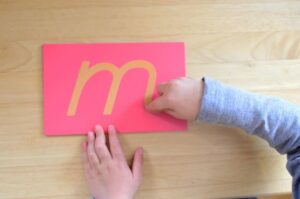
Can you imagine learning letters by feeling them rather than just looking at them? That’s exactly what sandpaper letters do! These wooden boards have raised letters made of sandpaper, allowing children to trace each shape with their fingers while saying the corresponding sound.
That’s how sandpaper letters help develop writing skills:
- Strengthens muscle memory for letter formation.
- Links sensory input with phonetic learning.
- Prepares children for smooth handwriting before they ever pick up a pencil.
Metal insets – The path to pencil control
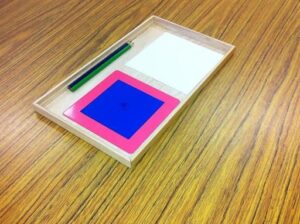
Ever wonder why Montessori children develop beautiful handwriting early on? It’s because of metal insets, a set of colorful geometric shapes with stencils that allow children to trace curves and angles — training their hands for writing before they even attempt letters.
Consistent practice provides the following benefits:
- Develops fine motor control and steady hand movements.
- Trains children to apply the right amount of pressure on a writing tool.
- Encourages precision and focus — two key skills for fluent writing.
Moveable alphabet – Writing without handwriting
A child could write words before they even learned how to hold a pencil properly. That’s what the moveable alphabet is for! It’s a set of wooden or plastic letters that children use to form words — helping them build spelling skills before they’re physically ready to write by hand.
The moveable alphabet supports the development of writing skills in the following ways:
- Encourages children to experiment with word formation at an early stage.
- Reinforces the sound-to-letter connection, making phonetic reading easier.
- Builds confidence in expressing thoughts in written form before actual handwriting.

Chalkboards and lined paper – The transition to writing
After working with sandpaper letters and metal insets, children gradually transition to writing using chalkboards and lined paper. Writing on a chalkboard feels more fluid and forgiving than paper, making it less intimidating.
Here is how it helps:
- Strengthens pencil grip and stroke control.
- Encourages children to practice letters and words independently.
- Allows for self-correction — erasing mistakes builds confidence!

Writing trays (sand or salt trays) – A sensory approach to letter formation
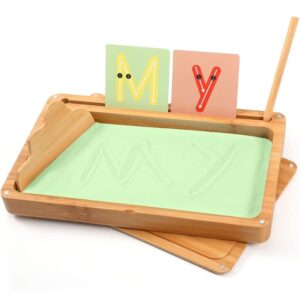
Before using a pencil, many children enjoy tracing letters in sand or salt trays. This activity feels like play, yet it builds essential writing skills:
- Reinforces letter formation in a stress-free way.
- Provides a sensory experience that strengthens memory.
- Helps children gain control over hand movements before using a pencil.
Montessori reading materials and activities
Once a child is familiar with letters through writing activities, reading follows naturally. But instead of relying on memorization, Montessori reading materials focus on phonetic awareness, ensuring children truly understand the mechanics of language.
Sound games – The first step to reading
How can a child start reading before ever seeing a book? The answer: Sound games! Montessori reading begins with listening — children learn to recognize letter sounds (phonemes) long before they see them on paper. How does it help?
- Develops phonemic awareness, the foundation of reading.
- Helps children distinguish between different sounds in words.
- Makes reading an interactive and fun process.
Phonetic object boxes – Making words real
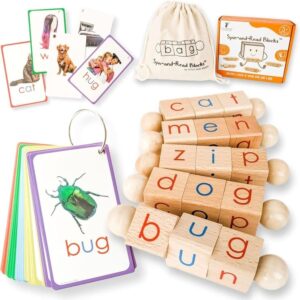
Instead of jumping straight into reading text, Montessori introduces phonetic object boxes — small objects that match their corresponding phonetic word cards (e.g., a toy cat with the word “cat”).
Using phonetic object boxes has several key benefits:
- Connects physical objects with written words.
- Reinforces sound blending — a key reading skill.
- Makes reading more hands-on and exciting!

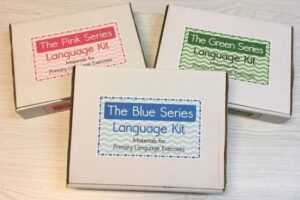
Pink, blue, and green series – The Montessori phonics progression
Montessori reading follows a step-by-step phonetic approach, using a color-coded system:
- Pink series – Simple three-letter (CVC) words like “cat” and “sun.”
- Blue series – Blends and digraphs like “ship” and “frog.”
- Green series – More complex phonograms like “night” and “house.”
Here is why it is beneficial:
- Gradually introduces reading in a logical progression.
- Prevents overwhelming children with complex words too soon.
- Builds confidence and fluency step by step.
Three-part cards – Expanding vocabulary and comprehension
Three-part cards contain a picture, a matching word, and a word label. Children use them to match and read while expanding their vocabulary.
Using three-part cards helps enhance reading skills as follows:
- Develops word recognition skills.
- Encourages visual and cognitive connections between objects and words.
- Makes learning interactive and engaging.
Early phonetic readers – The first books Montessori kids read
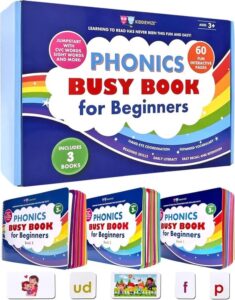
After mastering letter sounds and simple word formation, children are introduced to phonetic readers — small books with predictable, phonics-based text. The effectiveness of using these books is evident because:
- Provides a smooth transition from word-building to reading sentences.
- Reinforces confidence in independent reading.
- Ensures children read with understanding, not just memorization.
Why does this method work so well? Montessori literacy materials are backed by science, supporting how children naturally develop language and cognitive skills.
Scientific perspective on the Montessori method of teaching reading and writing
Decades of research, neuroscience, and cognitive development studies confirm what Maria Montessori observed over a century ago — children learn best when their hands and minds work together. The Montessori method of teaching reading and writing isn’t just a theory; it aligns perfectly with how the brain develops in early childhood. From fine motor skill development to phonemic awareness and multisensory learning, every aspect of Montessori reading and writing instruction is backed by scientific evidence. Let’s dive into the research behind this revolutionary approach!
How Maria Montessori’s observations align with modern science
Through years of careful observation, Maria Montessori discovered that children develop literacy skills most effectively when writing precedes reading. Today, neuroscience confirms her findings.
Studies show that writing engages multiple areas of the brain simultaneously — the motor cortex (movement), the visual cortex (letter recognition), and the language centers (phonemic awareness). When children trace letters with their fingers, manipulate a movable alphabet, or use sandpaper letters, they activate these regions, forming stronger neural connections. This multisensory approach makes reading easier, faster, and more intuitive.
Research confirms that fine motor skill development is directly linked to early literacy success. Studies have shown that children who engage in hand-strengthening activities — like tracing, cutting, and working with small objects — develop better handwriting and reading skills later on. Montessori’s metal insets, chalkboards, and practical life activities help children refine pencil grip and letter formation, which in turn improves their ability to recognize and read words effortlessly.
The Montessori reading method is phonics-based, meaning children learn letter sounds before letter names. Modern research overwhelmingly supports phonics as the most effective way to teach reading — helping children decode words rather than memorize them.
However, Montessori takes phonics a step further by incorporating multisensory learning. Instead of just hearing a sound or seeing a letter on a worksheet, children touch, move, and manipulate the letters themselves. This multisensory approach strengthens memory retention, ensuring that reading becomes effortless and natural.
While specific studies directly comparing Montessori’s phonetic approach to sight words or whole-language methods are limited, research supports the effectiveness of phonics-based instruction in developing reading fluency and comprehension. For instance, this study found that systematic phonics instruction significantly improved reading fluency in young learners.
Additionally, the National Reading Panel’s report emphasizes that phonemic awareness instruction enhances children’s reading skills, including both word reading and comprehension.
These findings align with the Montessori method’s emphasis on phonetic learning, suggesting that such an approach can lead to stronger reading outcomes compared to methods that do not prioritize phonics.
Montessori vs. traditional reading instruction: The research speaks
So, does the Montessori method produce better literacy outcomes compared to conventional teaching? The answer is a resounding yes!
Studies have found that:
- Montessori-educated children demonstrate higher phonemic awareness and print awareness. The study titled “The Effect of Montessori Education on the Development of Phonological Awareness and Print Awareness” examined how Montessori education influences early literacy skills. The findings indicated that children in Montessori programs showed significant improvements in both phonological and print awareness.
- Students taught using Montessori literacy techniques outperform their peers in writing ability and reading fluency. The research “Effects of Montessori Teaching Method on Writing Ability of Iranian Male and Female EFL Learners” explored the impact of Montessori methods on writing skills. Results revealed that students instructed through Montessori techniques achieved higher scores in writing assessments compared to those taught by traditional methods.
- Hands-on learning significantly improves literacy rates in slow learners compared to traditional methods. The study “Developing the Phonological Awareness of Pupils with Learning Difficulties: Montessori Activities” investigated the effectiveness of Montessori-based, hands-on activities in enhancing phonological awareness among students with learning challenges. The findings demonstrated that these tactile and interactive methods led to notable improvements in literacy skills for slow learners.
These studies underscore the effectiveness of Montessori methods in fostering literacy development across diverse learner populations.
What does this mean for parents and educators today? It means that Montessori reading and writing strategies are not just an alternative approach — they’re an evidence-based way to teach literacy effectively.
Even in non-Montessori classrooms, educators are increasingly adopting Montessori-inspired techniques, such as:
- Using phonetic-based reading instruction.
- Incorporating sensory learning tools like sandpaper letters.
- Prioritizing writing before reading to build literacy skills.
The Montessori method aligns perfectly with modern best practices in literacy education, proving that Maria Montessori was far ahead of her time.
Final thoughts: A lifelong love for reading and writing
The goal of the Montessori method of teaching reading and writing isn’t just to teach literacy — it’s to instill a lifelong passion for learning. When children discover letters through touch, form words before they read them, and build literacy skills at their own pace, they become confident, engaged, and excited about reading and writing.
Whether you’re an educator or a parent, Montessori literacy principles can be easily integrated into daily routines.
💡 Start with pre-writing activities! Encourage your child to trace shapes, work with clay, or use metal insets to strengthen hand coordination.
💡 Introduce phonetic learning early. Use sandpaper letters and sound games to build letter-sound recognition before formal reading begins.
💡 Make reading and writing a hands-on experience! Try moveable alphabets and phonetic object boxes to let your child experiment with words at their own pace.
💡 Follow your child’s interest. If they love nature, write letters in the sand! If they enjoy building, create word towers with letter blocks! Montessori is about adapting to the child’s natural curiosity.
Montessori goes beyond just one subject. See how each area connects to nurture independent, confident learners in our guide to the Montessori curriculum.
Want to dive deeper into Montessori literacy techniques? Visit the Montessori Family Center to discover more about these proven reading and writing methods. Together, we will help your child learn faster, more efficiently, and with joy!
FAQ: Montessori method of teaching reading and writing
1. Why does Montessori teach writing before reading?
Montessori prioritizes writing first because it is an easier cognitive process than reading. Writing is an output skill, where children express thoughts by forming letters, while reading requires decoding and comprehension, which is more complex. By focusing on pre-writing activities and phonetic awareness, Montessori ensures that reading develops naturally and effortlessly.
2. At what age should a child start learning to read and write the Montessori way?
Montessori literacy education starts indirectly from birth, with exposure to spoken language and sensory experiences. Formal pre-writing activities begin around age 2–3, with sandpaper letters, tracing, and moveable alphabets. Most Montessori children begin writing simple words by age 4 and reading phonetic books by age 5, but the process is individualized and pressure-free.
3. What are the best Montessori materials for teaching reading and writing?
Key Montessori reading and writing materials include sandpaper letters for tactile letter recognition, the moveable alphabet for word formation, metal insets to refine pencil control, sound games to develop phonemic awareness, and phonetic object boxes to link words with real-world meanings.
4. How does Montessori phonics differ from traditional phonics instruction?
Montessori phonics is multisensory and hands-on, incorporating touch, movement, and sound. Instead of memorizing sight words, children trace letters, build words, and connect sounds with real objects. This method enhances memory retention and makes reading more intuitive and engaging compared to traditional phonics drills.
5. Can Montessori reading and writing methods be used at home?
Absolutely! Parents can introduce sandpaper letters, movable alphabets, and phonetic books at home. Encouraging tracing, storytelling, and sound games supports literacy naturally. The key is to follow the child’s pace, make learning fun, and incorporate practical life activities that strengthen fine motor skills.
6. How does the Montessori method support children who struggle with reading?
Montessori literacy education is individualized, allowing children to learn at their own pace without pressure. Hands-on activities like tracing letters in sand or salt trays and using phonetic object boxes help struggling readers connect sounds to symbols in an engaging way. Montessori’s multisensory approach is particularly beneficial for children with dyslexia or other learning differences.
7. What is the role of movement in Montessori literacy education?
Montessori integrates movement with learning, reinforcing memory through tracing, writing, and physically building words. This approach engages the brain more effectively than passive learning. Activities like metal insets, sandpaper letters, and chalkboard writing help children develop the muscle memory and coordination needed for confident handwriting and reading.
8. Does Montessori use sight words in teaching reading?
Montessori focuses on phonetic decoding rather than memorizing sight words. However, some high-frequency words that don’t follow phonetic rules are introduced later using the green series. Unlike traditional methods, Montessori ensures children understand the structure of words first before relying on memorization.
9. How do Montessori schools assess reading and writing progress?
Montessori schools observe a child’s natural progression rather than using standardized tests. Teachers assess fine motor skills, phonetic understanding, and reading fluency through practical activities like writing with the Moveable Alphabet, reading phonetic books, and matching words with objects. Progress is measured individually, not by age or grade level expectations.
10. Can Montessori reading and writing methods be adapted for older children?
Yes! While Montessori literacy education is most effective when introduced early, older children can still benefit from multisensory phonics, tactile writing exercises, and hands-on reading activities. Even children struggling with literacy in traditional schools can gain confidence and skills through Montessori-inspired methods.
By incorporating these Montessori reading and writing techniques, both educators and parents can create a stress-free, engaging literacy experience that builds a child’s confidence and sets them up for lifelong learning success!
References and further reading
Explore these valuable resources for deeper insights into the Montessori method of teaching reading and writing, its benefits, and scientific research supporting its effectiveness.
- Teaching Reading and Writing the Montessori Way: A comprehensive look at Montessori’s hands-on approach to literacy, explaining how phonics, tactile materials, and independent learning foster reading and writing success.
- How Do Montessori Schools Teach Reading? This article explores the step-by-step Montessori reading process, from phonemic awareness to using phonetic books, providing insights for parents and educators.
- Montessori Reading and Writing: A detailed guide to the Montessori literacy framework, covering writing before reading, phonetic learning, and essential Montessori materials for literacy development.
- Why We Teach Writing Before Reading: Explains why Montessori prioritizes writing before reading, emphasizing the cognitive advantages and how it naturally transitions children into literacy.
- 5 Ways to Teach Reading and Writing Using a Montessori Approach: A practical resource outlining five key Montessori strategies that parents and teachers can use to support early literacy development at home or in the classroom.
- Teach Your Child to Read the Montessori Way: A parent-friendly guide on using Montessori phonics, hands-on reading activities, and early literacy techniques at home.
- How to Teach Reading Easily: Montessori Homeschooling Tips: A step-by-step approach to implementing Montessori reading strategies for homeschooling families.
- Montessori Language Resources and Literacy Activities: A collection of Montessori-aligned literacy activities, phonics lessons, and language development techniques for educators.