Table of Contents
- When do babies start crawling? (Timeline & milestones)
- Why crawling matters: The developmental benefits behind the movement
- How to help baby crawl: Gentle ways to encourage movement
- The Montessori approach to crawling: Why we don’t “teach” movement
- The ‘secret’ power of Montessori crawling groups
- When to worry about baby not crawling
- Final thoughts: Trusting your baby’s crawling journey
- FAQ: How to help baby crawl
Watching your little one explore the world is one of the greatest joys of parenthood — yet it often comes with moments of concern. If you are searching for how to help baby crawl and find yourself comparing your child’s progress to others at the park, you’re definitely not alone.
In a world filled with conflicting advice — from rigorous “tummy time” schedules to the strict “wait and see” approach — it can be difficult to know how to best support your baby’s physical development. You definitely want to encourage them, but, at the same time, you also want to respect their natural pace.
This is where the Montessori approach offers a refreshing perspective. Instead of “teaching” a baby to move, we focus on creating the perfect environment for movement to happen naturally.
In this guide, we will look beyond standard milestones. You’ll learn when babies start crawling, the science behind why it matters for brain development, and gentle, pressure-free ways to encourage movement. We will also reveal the “secret” power of Montessori crawling groups — and why socialization might be the missing piece of the puzzle for your baby’s motor skills.
Here is everything you need to know to support your baby’s journey from wobbly sitting to confident exploring.
When do babies start crawling? (Timeline & milestones)
Although most babies start crawling between 6 and 10 months of age, crawling doesn’t begin at exactly the same time for every child. While it is easy to compare your baby to the one next to you in playgroup, it is important to remember that every baby follows a unique developmental timeline. Understanding what is typical — and how much variation is normal — helps you support their movement without unnecessary pressure. To discover more about different ways babies learn to crawl and important timelines, follow this link: When do babies normally start crawling?
Why crawling matters: The developmental benefits behind the movement
Crawling is more than just a way to get from point A to point B — it is a full-body, full-brain workout that sets the stage for future learning. Research suggests that the experience of independent movement influences how different body systems interact, meaning that how a baby moves now can impact their physical and cognitive health years down the road.

How crawling boosts physical strength and coordination
Crawling strengthens nearly every major muscle group, building the foundation babies need for sitting, pulling up, and eventually walking. It specifically targets:
- Core stability: Essential for future posture, balance, and fine motor control.
- Shoulder and arm strength: The weight-bearing creates the stability needed for later skills like writing and dressing.
- Cross-lateral coordination: The “right arm, left leg” pattern builds the neurological bridge between the two hemispheres of the brain.
- Joint mobility: Constant movement keeps the hips and shoulders flexible and healthy.
What the science says: Recent research indicates that early crawling experience shapes long-term physical health. A 2022 network analysis found that children who crawled before walking showed better interactions between body composition, cardiovascular health, and motor competence years later: Network Analysis of Body-Systems Interactions.
Furthermore, preventing movement restrictions in infancy is crucial. Studies suggest that ample floor time contributes to maintaining healthy joint mobility and range of motion: Infant crawling and joint mobility research.
The link between crawling and brain development
Movement and brain development are deeply connected. Crawling supports early neural organization by forcing the brain to process visual, vestibular (balance), and proprioceptive (body awareness) information simultaneously.
Research indicates that crawling strengthens:
- Spatial awareness: Understanding “near,” “far,” “up,” and “down.”
- Problem-solving: Planning a route around a chair or over a pillow.
- Bilateral integration: coordinating the left and right sides of the brain.
What the science says: Evidence suggests that crawling-based exercises can support cognitive gains even in children with developmental challenges, reinforcing the link between movement and learning: Effect of crawling training on cognitive development.
Interestingly, this connection extends to behavior. A study conducted during the COVID-19 lockdown revealed that children who practiced crawling exercises at home demonstrated improved behavioral performance and self-regulation: Crawling exercise and behavioral performance.
Does skipping crawling affect future learning?
Many parents worry when their baby skips the “classic” hands-and-knees style, but it is important to look at the bigger picture.
Is skipping crawling a red flag? Generally, no. Most babies who skip crawling develop perfectly normally.
- Variation is normal: Commando crawling, scooting, and belly sliding are all valid forms of movement.
- The real warning sign: Lack of any independent movement or discomfort with shifting weight is more concerning than the specific style of crawling.
Here is why movement matters more than the “style.” The answer is fairly simple: The critical factor for brain development is independent locomotion — the ability to move oneself through space.
What the science says: Research consistently shows that it is the experience of moving independently that triggers cognitive leaps, such as a fear of heights (depth perception) and memory skills.
A pivotal study on spatial cognition found that infants with locomotor experience (whether crawling or using a walker) performed significantly better on spatial search tasks than those who could not yet move. This suggests that moving is what matures the brain, regardless of the exact method: Locomotor experience as a facilitator of spatial cognitive development.
How to help baby crawl: Gentle ways to encourage movement
When parents start wondering how to help their baby crawl, they often expect a list of exercises or a recommendation for a specific toy. However, the answer lies not in buying special equipment, but in removing obstacles.
Babies learn to crawl when they feel safe, supported, and free to explore. The goal is to offer opportunities — not pressure — so your baby’s body and brain can solve the puzzle of movement at their own pace.
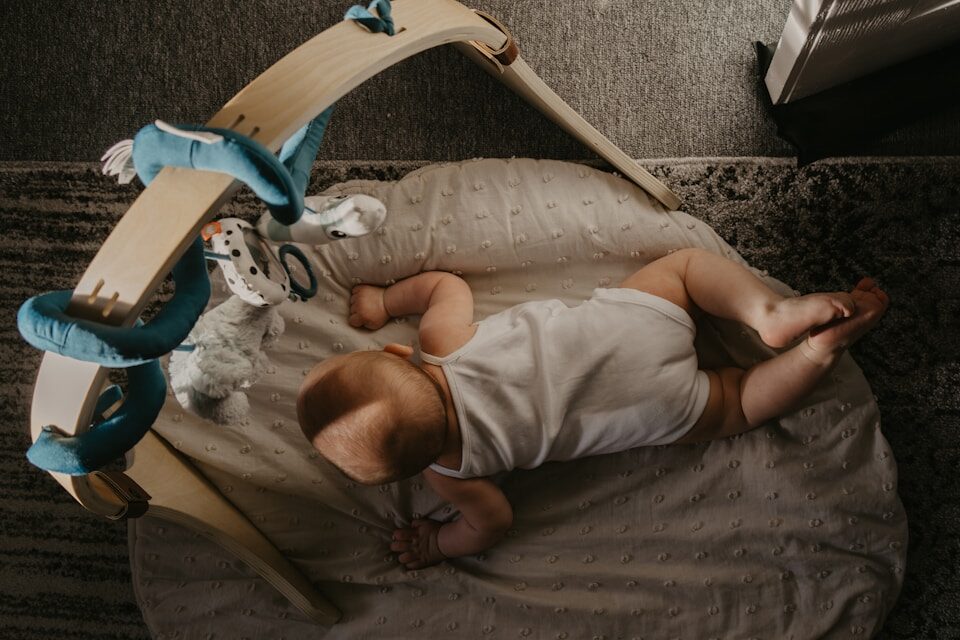
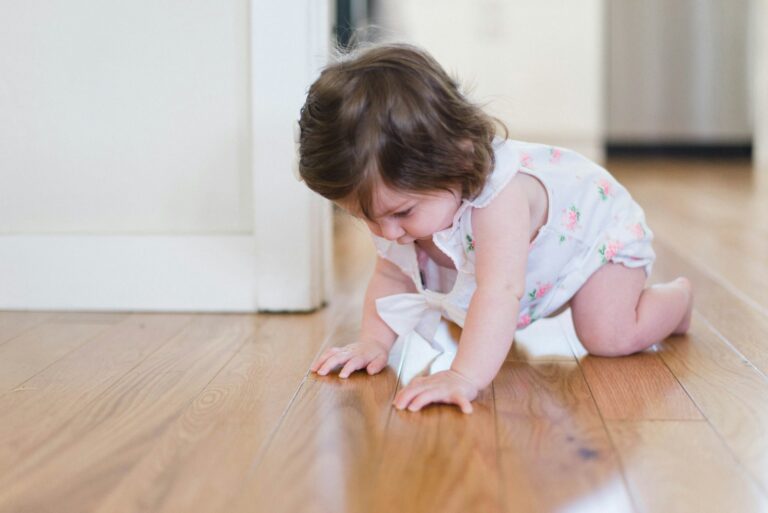
How to encourage baby to crawl using ‘floor time’
In the Montessori philosophy, the floor is the best classroom for crawling. “Floor time” gives babies the sensory feedback they need to understand their own bodies.
Here is how to optimize floor time for crawling:
- Choose the right surface: A super-soft bed or thick rug makes it hard to push off. A firm foam play mat or carpet offers the traction and resistance needed for knees and toes to grip.
- Use “The Lure”: Place a high-value toy (like a mirror or a ball) just inches out of their reach. This frustration is healthy — it triggers the weight shift needed to lunge forward.
- Get down on their level: Your face is the best motivation. Lie on your belly a few feet away; babies are naturally drawn to make eye contact.
- Create “Speed Bumps”: Once they are scooting, place a small rolled-up towel or your leg on the floor. Climbing over low obstacles builds the core strength required for hands-and-knees posture.
How to teach baby to crawl without pressure or propping
Parental instinct often says: “Maybe I should help by moving their legs for them.” However, babies learn best when they initiate the movement themselves. Passive movement (you moving them) does not build the same neural connections as active movement (them figuring it out).
Instead of propping or drilling, try these gentle strategies:
- Model the movement: Babies have mirror neurons (we will return to them later) that fire when they watch you. Get on all fours and crawl next to them. It’s fun, and it shows them exactly what to do.
- Support, don’t push: If they are struggling to get their knees under them, you can place your hand firmly against their feet to give them a “wall” to push off against, but avoid pushing them forward yourself.
- Avoid “Containers”: Devices like walkers, jumpers, and bouncers can actually delay crawling. They keep a baby upright before their core is ready, often leading to tight hips or toe-walking, which works against the mechanics of crawling.
The Golden Rule: Your baby doesn’t need to be “taught” in the traditional sense. They need time, space, and the biological freedom to try, fail, and try again.
Setting up a “Yes Space” for safe exploration
A “Yes Space” is a Montessori concept: a completely safe, enclosed area where you never have to say “No,” “Don’t touch,” or “Be careful.”
Why this helps crawling: If a baby is constantly stopped from exploring (“Don’t touch the outlet!”, “Watch out for the dog!”), they eventually learn that movement leads to restriction. In a Yes Space, movement leads to discovery.
Here is how to create a “Yes Space” at home:
- Clear the decks: Remove coffee tables, breakables, and trip hazards. Open space invites movement.
- Low shelves: Place toys on low, open shelves rather than in a toy box. This encourages the baby to pull up, scoot over, or crawl to select an item.
- Define the boundary: Use a playpen-style gate or close the door to a safe room.
- Rotate toys: Keep only 3-4 toys out at a time. Novelty sparks curiosity, and curiosity is the fuel for crawling.
Let’s focus on other aspects of the Montessori approach to crawling that make it unique.
The Montessori approach to crawling: Why we don’t “teach” movement
In the Montessori philosophy, movement is not a skill we impose on a child. It is an inner drive we prepare for. We believe that babies are born with an internal developmental blueprint. Our role as parents and caregivers is not to “train” them to crawl, but to remove the obstacles standing in their way.
When you shift from the mindset of doing (teaching) to facilitating (preparing), the entire parenting experience changes. The pressure to “perform” disappears, replaced by trust in your child’s natural timeline.

The difference between “teaching” and “facilitating”
Traditional parenting advice often focuses on mechanics: positioning limbs, propping babies up, or using “walkers” to simulate movement. In Montessori, this interference is unnecessary and potentially hindering.
What is the difference?
- Teaching implies that the adult holds the knowledge and must transfer it to the child (e.g., moving a baby’s legs for them).
- Facilitating implies that the child already knows how to develop, and the adult simply provides the resources to let it happen.
How to be a Facilitator:
- Observe first: Watch how your baby is trying to move. Are they pushing with their toes? Are they frustrated? Observation tells you what they need next.
- Prepare the space: Instead of holding them, place them on a mat where they have traction.
- Allow the struggle: It sounds harsh, but the “wobble” and the struggle are where the muscles and neural pathways are built. Rescuing them from every frustration robs them of the victory of figuring it out.
The Result: When a baby discovers crawling on their own, they develop self-efficacy — the belief that “I can do this.”
Freedom of movement: Why clothing and environment matter
One of the core pillars of the Montessori method is Freedom of Movement. This isn’t just about floor time; it starts with what the baby wears and how their room is set up. Let’s explore these two aspects.
1. Clothing: The “Second Skin”. You cannot crawl if you cannot feel the floor. Keep these two aspects in mind:
- Bare feet are essential: Babies receive sensory feedback through their feet (proprioception). Socks, especially on wood floors, are slippery and dangerous for a learner. Bare feet provide the grip needed to push off.
- Comfort over style: Avoid stiff denim, tight waistbands, or dresses that get caught under knees. Opt for soft, stretchy fabrics that allow for a full range of motion.
2. The Prepared Environment. Does your home invite movement, or does it say “sit still“? Following just these three steps will help your baby start crawling:
- The Low Mirror: A horizontal mirror at floor level encourages the baby to lift their head (tummy time) and eventually pull themselves forward to “meet” the baby in the glass.
- Low Shelves: Instead of a toy box, place toys on a low shelf. This visual cue creates a goal: “I see the rattle, and I must move to get it.”
- Firm Surfaces: Deep-pile carpets absorb energy. A firm play mat gives the resistance needed to push against gravity.
Respecting natural milestones: Why Montessori doesn’t rush
In a world obsessed with “earlier is better,” Montessori offers a breath of relief: Development is not a race.
Every baby has a unique internal clock. Some crawl at 6 months, others at 10, and some skip crawling to go straight to cruising. This is what you need to keep in mind:
- Readiness vs. Pressure: We wait for signs of readiness (rolling, pivoting) rather than forcing a milestone the body isn’t ready for.
- Mastery takes time: A baby might spend weeks just rocking on hands and knees. This isn’t “stalling” — it is the brain mapping out balance and weight distribution.
- Confidence: When we don’t rush them, babies learn to trust their own bodies.
The Takeaway: If your baby is happy, engaged, and exploring, they are exactly where they need to be. Your job, as a parent, is to provide the floor, the freedom, and the faith that they will move when they are ready.
The ‘secret’ power of Montessori crawling groups
While babies can certainly learn to crawl at home, Montessori crawling groups offer something no living room can fully replicate: social learning.
What looks like simple play to an observer is actually a rich developmental experience. This is the “secret” ingredient often missing from solo practice: the power of seeing peers do exactly what you are trying to do.
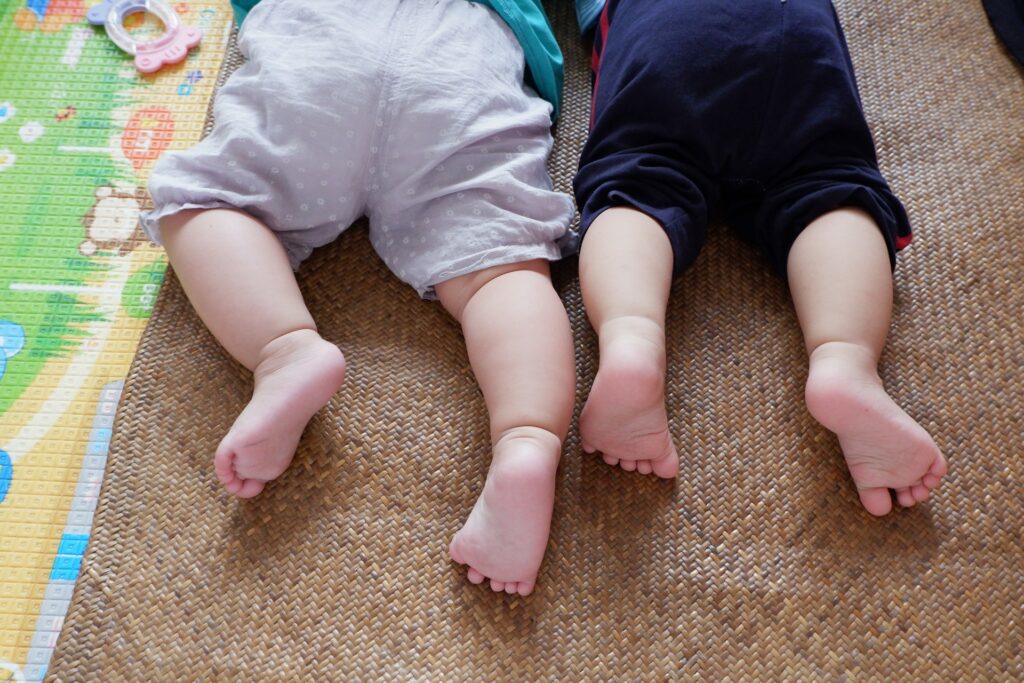
How peer observation triggers the desire to move
Just like by watching their parents, babies can learn an enormous amount simply by watching other babies. This is driven by the exact same mirror neurons — brain cells that fire both when we perform an action and when we observe someone else doing it.
But here is a small but very impactful insight: a group works better than a parent. And this is why:
- Relatability: When a baby sees an adult crawl, it looks impossible (our limbs are huge!). When they see a peer do it, it looks achievable.
- The “Visual Blueprint”: Younger babies watch older peers rock, scoot, and pull up. This provides a live demonstration of the mechanics of movement.
- Positive Frustration: Seeing a friend reach a toy stimulates a healthy desire to keep up.
It is not competitive pressure — it is developmental inspiration. Montessori environments intentionally mix ages (even by just a few months) so that one baby’s movement becomes another baby’s invitation to try.
Why groups help babies who refuse to crawl at home
We hear this constantly from parents: “My baby never moves like this at home, but they started crawling the minute we got here!”
Why does the group succeed where the living room fails?
- Fewer Distractions: Homes are full of “noise” — blinking electronics, pets, piles of laundry, and busy siblings. A Montessori group is calm and neutral, allowing the baby to focus entirely on their body.
- The “Parent Pause”: At home, it is natural to pick up your baby the moment they whine. In a group, we encourage parents to pause and observe. Often, that extra 30 seconds is when the baby solves the problem and moves forward.
- Novelty: A new space with new textures creates a “alert” state in the brain that is perfect for learning.
Sensory benefits of a prepared group environment
In Montessori, we call the environment the “Third Teacher.” It guides the baby without a single word being spoken.
Our crawling groups are engineered with specific sensory tools that are hard to set up at home:
- Low Mirrors: Placed at floor level, these help babies understand their body position (proprioception).
- Ramps and Tunnels: Gentle inclines encourage weight-shifting, which is the precursor to crawling.
- Natural Materials: Wood, wool, and woven baskets offer a “tactile grip” that plastic toys don’t provide.
- Safe “Yes” Space: Because the entire room is safe, parents relax. When parents relax, babies feel secure enough to take risks.
Ready to see the difference in teaching your baby to crawl?
If you want to give your baby a space where they are free to explore, struggle, and succeed alongside new friends, we would love to welcome you.
Join the next Montessori Crawling Group here: 👉 Book Your Spot at the Montessori Family Center
When to worry about baby not crawling
Since we know that the timeline for crawling is wide (and often skipped entirely), looking at the calendar alone isn’t the best way to spot a problem. Instead of counting months, look at the quality of movement.
The most important question isn’t “Is my baby crawling?” but rather “Is my baby stuck, or are they finding their own way to explore?”
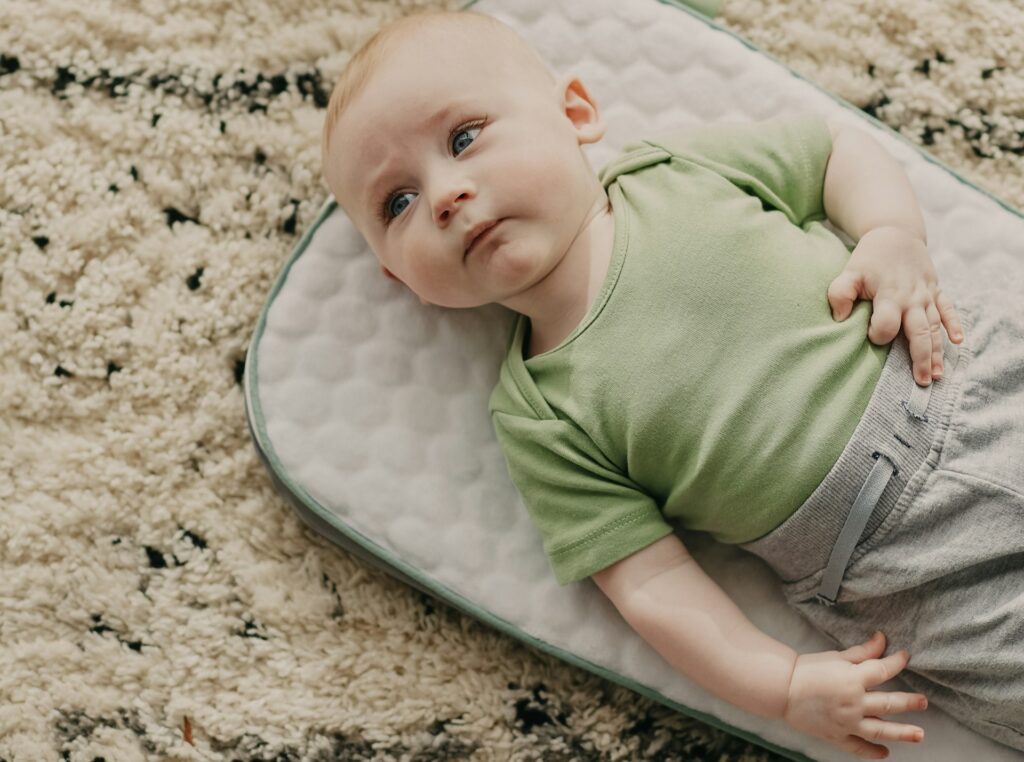
Baby not crawling at 9 months — is this okay?
Short Answer: Yes. A baby not crawling at 9 months is still well within the typical developmental window. However, at this stage, you should see active preparation.
Instead of worrying about forward motion, check for these “Pre-Crawl” indicators. If you see these, your baby is likely just building strength:
- The Pivot: Can they spin around on their belly to reach a toy to their side?
- The Rock: Do they get on hands and knees and rock back and forth? (This is the brain calibrating balance.)
- The Transition: Can they move from sitting to lying down (or vice versa) without falling?
Verdict: If your baby is eager to move, rolls to get toys, or pivots in circles, they are on track. They haven’t stalled; they are processing.
Baby not crawling at 12 months — when to seek advice
By the first birthday, the absence of crawling falls into two categories: the “Alternative Movers” and the “Stationary Babies.”
1. The Alternative Movers (Usually Fine). If your baby isn’t crawling on hands and knees but is bottom-shuffling, rolling rapidly, or pulling up to cruise on furniture, they have likely found a workaround.
Note: Some babies skip crawling to go straight to walking. As long as they are upright and bearing weight on their legs, this is generally considered a variation of normal.
2. The Stationary Babies (Seek Advice). It is time to consult your pediatrician if your 12-month-old is content to stay exactly where you put them:
- The “Sitter” Trap: If they sit perfectly but cannot get out of a sitting position to reach a toy.
- Lack of Curiosity: If a toy rolls away and they lose interest rather than trying to follow it.
Red flags: Signs that require a pediatric assessment
Regardless of age, certain physical signs warrant a professional evaluation to rule out underlying issues with muscle tone or neurological development.
Watch for “Tone” Issues:
- Hypotonia (Low Tone): The baby feels “floppy” or like a ragdoll when lifted; they struggle to hold their head up against gravity.
- Hypertonia (High Tone): The baby feels stiff or rigid; their legs cross stiffly (scissoring) when you pick them up.
Watch for Asymmetry:
- Lopsided Movement: They only reach with one hand while the other stays fisted.
- One-Sided Drag: When they try to crawl, they drag one leg while the other does all the work.
Watch for Behavioral/Skill Signs:
- Regression: Any loss of a skill they previously had (e.g., they used to roll, but now they don’t). This is always an urgent sign.
- Extreme Distress: A baby who screams in pain (not just annoyance) whenever placed on their tummy, even for short bursts.
Remember: An assessment is not a diagnosis of a disorder — it is simply a tool to see if your baby would benefit from physical therapy (PT) to get them back on track.
Final thoughts: Trusting your baby’s crawling journey
Watching your little one explore the world is one of the greatest joys of parenthood, even if it often comes with moments of concern. It is easy to get caught up in comparing milestones, but remember that development is rarely linear.
If you are looking for how to help your baby crawl, the most effective “secret” is a shift in perspective. Instead of feeling the need to “teach” movement, you can embrace the role of the facilitator. By shifting your mindset from doing to facilitating, the pressure to perform disappears, replaced by trust in your child’s natural timeline.
To support your baby’s journey, remember these three core principles:
- Prepare the Environment: Create a “Yes Space” where movement leads to discovery rather than restriction. Remove obstacles so your baby can solve the puzzle of movement at their own pace.
- Embrace Social Learning: Never underestimate the power of peer observation. A Montessori crawling group can provide “developmental inspiration” and a visual blueprint that is difficult to replicate at home.
- Trust the Process: Whether your baby is an “Early Explorer” or a “Late Bloomer,” they are following a unique internal clock.
Ultimately, your job as a parent is simple yet profound: to provide the floor, the freedom, and the faith that they will move when they are ready.
Ready to support your baby’s movement in a beautifully prepared, research-aligned space? Explore the Montessori Crawling Group and give your little one the freedom, confidence, and inspiration to move at their own pace in a safe, nurturing environment that encourages natural movement, peer inspiration, and joyful exploration.
FAQ: How to help baby crawl
1. How can I help my baby crawl without pressuring them?
The best way to help your baby crawl is not by “teaching” them, but by removing obstacles and offering opportunities. To encourage movement, create a safe “Yes Space” with a firm floor surface rather than a soft bed or rug, which makes it hard to push off. Place high-value toys just out of reach to trigger the necessary weight shift and motivation.
2. What age do babies start crawling?
Most babies start crawling between 6 and 10 months of age. However, there is a wide range of normal; some “Early Explorers” begin as early as 4 months, while “Late Bloomers” may start closer to 11 or 12 months. If your baby was born prematurely, always calculate this milestone based on their adjusted age.
3. My baby is not crawling at 9 months. Should I be worried?
No, a baby not crawling at 9 months is still well within the typical developmental window. Instead of forward motion, look for signs of active preparation, such as pivoting on their belly, rocking on hands and knees, or transitioning between sitting and lying down. These actions show that the brain and muscles are preparing for movement.
4. How do I teach my baby to crawl?
In the Montessori approach, we believe babies do not need to be taught in the traditional sense; they need to be facilitated. You can model the movement by crawling next to them to activate their mirror neurons. Avoid passive movement, such as moving their legs for them, as this does not build the same neural connections as when they figure it out themselves.
5. When should I worry about my baby not crawling?
You should consider seeking advice if your baby is not crawling at 12 months and is “stationary” — meaning they are content to stay exactly where placed without curiosity or attempts to move. Other red flags that warrant a pediatric assessment include regression of skills, low muscle tone (floppiness), stiffness, or an extreme aversion to tummy time.
6. Why do Montessori crawling groups work better than practicing at home?
Montessori crawling groups utilize “social learning,” where babies are inspired by watching peers. Seeing another baby crawl provides a “visual blueprint” that looks achievable, unlike watching an adult. Additionally, the group environment is free of home distractions and equipped with sensory tools like low mirrors and ramps to naturally guide movement.
7. Does skipping crawling affect development?
Many babies skip the classic hands-and-knees crawl and do fine. Research suggests that the critical factor for brain development is “independent locomotion” — the ability to move oneself through space — regardless of the specific style. As long as your baby is exploring and moving (scooting, rolling, or cruising), they are developing the necessary spatial and cognitive skills.