Children have a natural desire to build, connect, and shape the world around them. From stacking blocks to arranging sticks in the garden, these simple actions form the basis of construction play — a type of learning where imagination and logic meet. Far more than a pastime, construction play nurtures focus, coordination, and creativity, helping children understand how things fit together both physically and conceptually.
In Montessori education, this hands-on exploration is essential. By using real materials and working at their own pace, children learn to plan, test, and refine their ideas independently. Whether indoors with wooden blocks or outdoors in a backyard construction play area, every structure becomes an opportunity to think critically, collaborate, and discover cause and effect through experience.
This guide explores what construction play is, why it is important, and how it aligns with the Montessori method. You’ll also find practical ideas for indoor and outdoor setups, examples of Montessori-inspired construction play sets, and gentle ways parents can support this process at home.
Table of Contents
- What is construction play?
- Types and materials of construction play
- Construction play and the Montessori method
- Why is it important? The educational and developmental benefits of construction play
- Indoor and outdoor construction play ideas: Practical examples and sensory variations
- The role of adults and guided scaffolding
- Final Words: Play that unites body, mind, and emotion
- FAQ about construction play
What is construction play?
Construction play — also called constructive play — is a natural stage of early childhood in which children use materials to build, stack, and create something intentionally. It differs from exploratory or functional play, where children simply experiment with objects, because here their actions are guided by purpose. Whether forming a tower, connecting blocks, or designing a small world, the child is already thinking, planning, and testing ideas.
Jean Piaget described constructive play as the bridge between functional and symbolic play — the moment when children begin to combine ideas with physical actions to produce something new. In Montessori terms, this is when the hand becomes an instrument of the mind: children learn not by being told, but by doing.
Construction play typically begins around 18 months, when a toddler starts stacking or connecting two objects, and grows in complexity by ages 2 to 6, as the child learns to plan, balance, and represent real-world ideas through building. It’s the first expression of engineering in its purest form — where imagination meets logic, and curiosity takes physical shape.

At its heart, construction play teaches that the world can be transformed through effort. As children experiment with gravity, balance, and weight, they are not only discovering physical laws but also developing cognitive, emotional, and social skills that will support every later stage of learning.
Types and materials of construction play
Construction play exists on a spectrum from simple to complex, and can involve a wide variety of materials. The goal is not the finished product, but the process of building, testing, and understanding how materials behave in a child’s hands.
| Category | Examples & Context | Key skills developed |
| Traditional block & brick play | Wooden blocks, LEGO®, Duplo, magnetic tiles | Spatial awareness, fine motor control, problem-solving, collaboration |
| Natural & open-ended materials | Sticks, stones, sand, shells, recycled boxes | Creativity, texture exploration, sustainability awareness |
| Sensory construction | Oobleck, sand dough, cereal, clay | Sensory integration, cause-and-effect, tactile feedback |
| Woodworking / risky construction | Supervised use of tools, nails, wood scraps | Planning, resilience, confidence, safety awareness |
| Integrated or thematic construction | Building houses, vehicles, bridges, or “small worlds” for storytelling | Narrative thinking, STEM exploration, imagination |
| Everyday or culinary construction | Assembling parfaits, sorting utensils, stacking cups | Fine motor precision, sequencing, real-life relevance |
Construction materials can be store-bought, natural, or homemade. The crucial element is openness — the material should invite experimentation rather than dictate results. When children are free to explore and test their own designs, they engage both creativity and logic, leading to deep, authentic learning.
Traditional block and brick play
This is often the first form of construction play a child encounters. Wooden blocks, LEGO®, Duplo, and magnetic tiles offer endless opportunities for stacking, balancing, and pattern recognition. Through these toys, children explore symmetry, gravity, and stability while strengthening hand–eye coordination.
In Montessori settings, block play echoes the function of Sensorial materials — precise, ordered, and deeply engaging. Working with blocks also fosters collaboration, as children share ideas and build together, learning to communicate and compromise.
Natural and open-ended materials
Nature offers the richest construction materials of all. Sticks, stones, leaves, sand, and recycled boxes invite children to build freely, guided by curiosity rather than instruction. These materials change with weather and texture, helping children observe transformation and impermanence — a core Montessori insight.
Using what the environment provides nurtures creativity and environmental awareness, as children see that beauty and function can come from simple, natural resources.
Sensory construction
Adding a sensory element turns building into a multi-sensory learning experience. Bases like oobleck, sand dough, or even dry cereal encourage children to explore texture, resistance, and transformation. Mixing, pouring, and pressing materials stimulate fine motor strength and sensory integration.
This kind of play also supports early STEM learning — children observe cause and effect as materials shift between solid and liquid, heavy and light, sticky and firm.
Woodworking and risky construction
Under gentle adult supervision, woodworking introduces a sense of real responsibility. Using small hammers, nails, and pieces of wood, children learn about planning, sequencing, and safe tool handling.
Montessori philosophy values this kind of purposeful “real work,” where children feel trusted and capable. When a structure collapses or a plan needs revising, they also learn resilience — a lesson that extends far beyond the workshop.
Integrated or thematic construction
Sometimes construction becomes a stage for storytelling. A tower becomes a castle, a bridge connects lands, and a pile of blocks transforms into a bustling city. These projects blend imaginative play with engineering thinking, as children build environments for their stories.
It’s a form of early design thinking — combining creativity with structural logic. Montessori educators often connect this with “cosmic education,” where children explore how all parts of the world fit together.
Everyday or culinary construction
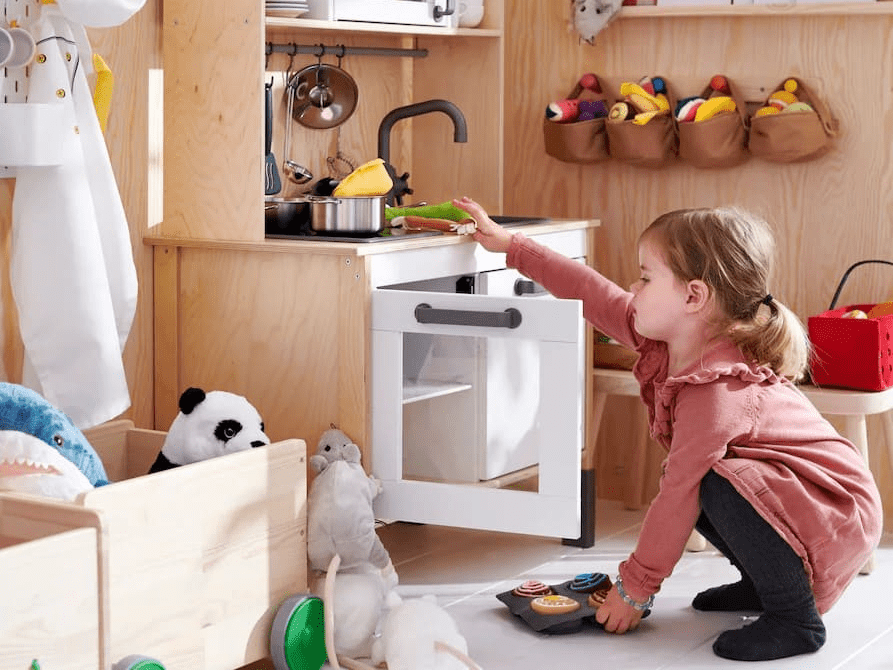
Construction play doesn’t always happen in the playroom. At home, daily routines offer similar opportunities: stacking cups, preparing food, or assembling a parfait layer by layer. These kitchen activities for children involve precise hand movements, sequencing, and patience. The same coordination is common to Montessori practical life exercises. Daily construction reminds us that learning can happen naturally in all spaces where a child works with intention.
After exploring the many forms of construction play — from sensory building to everyday tasks — it becomes clear that this kind of activity feels naturally at home within Montessori education. Both approaches value movement, independence, and the freedom to experiment. Yet to understand this harmony more deeply, it’s worth looking at how construction play aligns with the Montessori method.
Сonstruction play and the Montessori method
In Montessori classrooms, children are encouraged to learn through purposeful activity, guided by their curiosity and the materials before them. Construction play mirrors this process perfectly. Both nurture concentration, problem-solving, and the quiet joy that comes from creating something with one’s own hands.
A simple construction play set — wooden blocks, magnets, or natural materials — works in the same way as classic Montessori tools. The Pink Tower, Broad Stair, and Constructive Triangles all invite the child to compare, balance, and correct their own mistakes through direct experience. The focus is not on the final tower or pattern, but on how the child observes, adjusts, and refines their work.
Both construction play and Montessori practice rely on self-correction rather than adult instruction. When a tower collapses, the child learns naturally about gravity, proportion, and patience. When a bridge stands firm, it brings quiet satisfaction — a reflection of effort and understanding.
This alignment also extends to the values behind the work. Construction play fosters independence and confidence as children test their own ideas, while Montessori materials cultivate the same traits through carefully designed activities that meet the child’s developmental stage. In both settings, the adult’s role is to prepare the environment, then step back and observe.
Through these shared principles — hands-on exploration, real tools, self-correction, independence, and concentration — construction play becomes more than simple building. It transforms into an act of discovery, perfectly echoing the Montessori vision of learning through purposeful movement and mindful creation.
Why is it important? The educational and developmental benefits of construction play
After seeing how naturally construction play fits within the Montessori approach, it’s easy to understand why this kind of play is so important. Beyond the joy of stacking blocks or building towers, children are actually developing a wide range of foundational skills that prepare them for later learning — in mathematics, language, social interaction, and emotional growth.
Across many studies and observations, eight consistent developmental domains emerge where construction play delivers meaningful, measurable growth.
Cognitive and scientific reasoning
Construction play strengthens a child’s ability to observe, compare, and predict outcomes. While balancing blocks or experimenting with weight, children intuitively grasp concepts like symmetry, measurement, and stability.
A 2020 study published in the International Journal of Environmental Research and Public Health showed that guided construction play significantly improved 5- to 6-year-olds’ understanding of mass and stability — the foundation for later physics and engineering knowledge.
STEM readiness
This kind of play naturally builds early STEM thinking. As children ask, “What happens if I move this?”, they are forming hypotheses, testing ideas, and revising them — the same process scientists and engineers use.
The research on Preschoolers’ Spatial Assembly Performance and Early Mathematics Skills links early block play with stronger mathematical skills later in school, showing that play and academic readiness grow side by side.
Fine and gross motor skills
Through pinching, lifting, balancing, and joining pieces, children refine both fine and gross motor control. Activities like stacking, digging, or shaping materials strengthen small hand muscles and build core stability.
As highlighted by NHS Greater Glasgow, these experiences support hand–eye coordination, dexterity, and spatial precision, which later influence writing and daily practical tasks.
Creativity and imagination
Construction play is deeply open-ended — a tower might become a castle, a bridge, or even a spaceship. Children project ideas onto their creations, blending real-world understanding with imagination.
When combined with pretend play, construction turns into storytelling: a form of early narrative expression that supports language, empathy, and flexible thinking.
Social and emotional growth
Collaborative building teaches essential social skills such as sharing, turn-taking, and teamwork. Negotiating space and roles nurtures empathy and respect for others’ ideas.
Emotionally, construction play provides a safe way to experience success and failure. When a tower falls, the child learns resilience and self-regulation; when it stands, they feel genuine pride. These experiences are considered key steps in developing persistence and emotional maturity.
Language and communication
Describing their plans — “I’ll put this on top,” or “Let’s make it taller” — helps children practice expressive language and sequencing. As they collaborate, they explain reasoning, listen, and adjust, developing both vocabulary and conversational rhythm. This verbal reflection deepens understanding, turning thought into language.
Executive functions and planning
Every construction project requires organization, memory, and problem-solving. Children plan where to begin, test stability, and decide what to change. These actions strengthen working memory and attention control — the same mental skills used in reading, math, and everyday decision-making.
Self-esteem and confidence
Finally, construction play offers visible proof of effort and success. Finishing a structure — or even learning how to rebuild it — reinforces a sense of competence and self-belief.
When adults respond with quiet observation rather than correction, children learn that their own persistence leads to achievement. This sense of mastery builds confidence, curiosity, and motivation for lifelong learning.
Through these eight interconnected areas, construction play becomes more than recreation. It becomes a foundation for intellectual, emotional, and physical development, answering clearly the question “why is construction play important?”
Indoor and outdoor construction play ideas: Practical examples and sensory variations
After understanding why construction play matters so deeply, the next step is to create the right environment for it. Whether indoors or outdoors, what truly defines a construction play area is freedom — space to move, materials to explore, and time to think.
Indoor environments — Calm, organized, and inviting
A well-prepared indoor space helps children focus on the process of building rather than the clutter around them. Choose a quiet corner with open shelves and floor space where children can spread out their work.
A simple construction play set — such as wooden blocks, magnetic tiles, or recycled boxes — offers endless opportunities to experiment with balance and shape. Montessori classrooms often use unit blocks or Knobless Cylinders similarly: to build precision, control, and awareness of dimension.
You can enrich indoor construction play by including:
- Movable materials — trays of loose parts like corks, fabric scraps, sticks, or stones that can be added to or removed from structures.
- Rotating themes — one week focused on bridges, another on towers or small houses.
- Practical life extensions — building with natural materials after a nature walk, or integrating measuring cups and scales to explore weight and volume.
These construction play toys are not meant to distract, but to direct attention toward observation, pattern, and mindful repetition. The goal is not to build higher, but to notice more.
Outdoor construction play area — freedom to build on a larger scale
Either in the Montessori setting or not, outdoor play becomes wonderfully physical. The outdoor construction play area can be as simple as a patch of sand and loose branches or as elaborate as a designated mud-and-stone yard. The natural world provides all the variation a child needs — different textures, weights, and challenges.
In a backyard construction play area, children can:
- Use wooden planks, crates, and logs to build ramps or bridges.
- Experiment with construction sand or small stones for digging and piling.
- Combine recycled materials — cardboard boxes, old pots, buckets — to design forts or simple shelters.
- Practice safe, supervised tool use: small hammers, spades, and brushes.

Whenever possible, allow children to plan and change their environment, deciding where materials go or how to rebuild after a collapse. Freedom balanced with gentle supervision teaches responsibility and problem-solving — two essential Montessori values.
For younger children, provide clear boundaries and soft materials. For older ones, offer real challenges — heavier planks, natural obstacles, or opportunities to work together on shared projects. The best outdoor construction areas evolve with the child, expanding as their confidence grows.
Simple Montessori-inspired construction play sets
Choosing toys for construction play is less about brand and more about purpose. Montessori-inspired materials should be open-ended, tactile, and real — inviting exploration rather than prescribing outcomes.
Here are a few timeless options:
- Wooden unit blocks — foundational for understanding dimension, symmetry, and balance.
- Magnetic tiles — ideal for exploring shape and transparency while strengthening fine motor skills.
- Natural loose parts — smooth stones, wooden discs, seed pods, or shells collected from nature.
- Child-sized tools — a small hammer, screwdriver, or nuts and bolts board for early practical life work.
- Sustainable materials — unfinished wood, metal, or fabric instead of plastic, emphasizing care for the environment.
After setting up rich indoor and outdoor environments for construction play, one question naturally arises: “What is the adult’s role?”
The role of adults and guided scaffolding
The answer is simple: to guide without controlling, to prepare the space and language that help the child think more deeply, but never to interfere with discovery.
When children build, they are not only learning about structure and balance but also about patience, logic, and persistence. The adult’s task is to notice these moments of concentration and provide the kind of support that expands learning — not by giving answers, but by asking thoughtful questions and offering encouragement.
Meaningful adult interaction enhances the value of construction play, especially when it comes to language and reflection. Montessori called this process scaffolding the child’s independence: giving just enough help to allow success, but not so much that it interrupts exploration.

Best practices for gentle guidance
As an adult in construction play, you can become both a quiet observer and a thoughtful partner by following these simple steps:
- Provide ample, diverse, open-ended materials. Offer a variety of shapes, textures, and sizes so children can experiment freely. Open-ended materials — from wooden blocks to recycled pieces — invite problem-solving and creativity.
- Ask open questions rather than giving instructions. Replace “Do it this way” with curiosity: “What might happen if you add another block?” or “How could you make it stronger?” These prompts help children predict, plan, and evaluate outcomes — developing early reasoning skills.
- Encourage observation and prediction. According to the study mentioned above, you can support early scientific thinking by only inviting children to test ideas and reflect on what they see.
- Integrate reflection. After building, ask gentle questions: “What worked well?” or “What changed when you used bigger blocks?” Reflection helps children internalize learning and connect effort with outcome.
- Allow teardown and rebuilding. Dismantling is part of learning. When a structure falls or is rebuilt, children understand transience and develop flexibility — essential traits for resilience and creative problem-solving.
- Ensure inclusive access. Provide larger, lighter materials for beginners and more complex pieces for advanced learners, ensuring every child feels capable and engaged.
- Blend guided and free play. Alternate between open exploration and gentle challenges — for example, “Can you build a bridge that holds a toy car?” This mix encourages experimentation while still giving children autonomy to find their own solutions.
By preparing the environment, offering rich language, and stepping back at the right moment, we allow children to construct not only towers and bridges — but also the inner framework of confidence, curiosity, and independent thought that defines lifelong learning.
Final Words: Play that unites body, mind, and emotion
Construction play is one of the most integrative and powerful forms of learning in early childhood. It unites body, mind, and emotion: fine-tuned hands meet active imagination, guided inquiry meets sensory discovery. Whether a child is stacking wooden blocks, mixing “cement” from sand dough, or designing a cardboard city, they are quietly developing mathematical reasoning, scientific intuition, and a lasting joy in experimentation.
For educators and parents, the task is not to direct, but to curate spaces and gentle prompts that help children transform play into understanding. Each tower, bridge, or structure becomes a metaphor for growth — built patiently, tested bravely, and refined through experience.
In the end, construction play is more than building — it’s becoming. Each time a child constructs something new, they are also constructing themselves: their confidence, independence, and understanding of the world.
At the Montessori Family Center, children can explore thoughtfully prepared environments designed to nurture this kind of purposeful play. Here, every material — from wooden blocks to outdoor building tools — invites curiosity, focus, and collaboration.
We warmly invite parents to bring their children and experience the joy of construction play firsthand — to see how building with their own hands can also build the foundations for a lifetime of learning.
FAQ about construction play
1. What is construction play?
Construction play is a form of hands-on learning where children build, stack, and create using materials like blocks, sand, or recycled items. It helps them explore shape, balance, and cause and effect while developing focus and problem-solving skills.
2. Why is construction play important?
Construction play is important because it supports every area of development — cognitive, physical, emotional, and social. Through building and experimenting, children strengthen fine motor control, spatial awareness, creativity, and confidence.
3. What do children learn from construction play?
Children learn to plan, test ideas, and adapt when something doesn’t work. They explore early concepts of math and science, improve communication while building with others, and gain patience through trial and error.
4. What are the benefits of construction play?
The benefits of construction play include better hand-eye coordination, stronger reasoning skills, language growth, and emotional resilience. It encourages focus, collaboration, and pride in accomplishment — all foundations for lifelong learning.
5. How does construction play align with the Montessori method?
Construction play aligns perfectly with the Montessori method because both emphasize independence, creativity, and learning through real materials. Montessori tools like the Pink Tower or Constructive Triangles offer the same hands-on exploration and self-correction found in open-ended building play.
6. What materials can I use for construction play at home?
Simple materials work best — wooden blocks, magnetic tiles, sand, sticks, stones, and recycled boxes. Open-ended materials let children explore freely without fixed outcomes, encouraging imagination and experimentation.
7. How can I create an outdoor construction play area?
A backyard construction play area can include sand, planks, buckets, crates, or natural elements like logs and stones. Make sure the space is safe and flexible so children can build, dig, and redesign their environment independently.
8. What’s the difference between construction sand and play sand?
Play sand is soft and fine-grained, designed for safe sensory play. Construction sand is coarser and heavier, better suited for large-scale outdoor building. Mixing both can offer varied textures and building challenges.
9. How can parents support construction play without taking over?
Ask open questions such as “What might happen if you add another block?” and allow children to solve problems on their own. Provide a variety of materials, observe quietly, and celebrate effort rather than results.
10. Where can my child experience Montessori-inspired construction play?
At the Montessori Family Center, children explore purposeful building activities in a calm, prepared environment. They can work with natural materials, tools, and open-ended sets that encourage independence, focus, and joyful discovery.