The Montessori music is more than just entertainment — it’s a vital force in a child’s development. From the moment babies hear the rhythm of a heartbeat to the joyful clapping of toddlers and the structured melodies played by preschoolers, music influences how children think, feel, and move. It enhances brain function, emotional intelligence, and physical coordination, making it an essential part of early education.
Music in Montessori is beyond traditional lessons. It is integrated into daily learning as a sensorial experience, a form of self-expression, and a tool for cognitive growth. Unlike conventional methods that focus on rote memorization, Montessori music encourages children to explore sounds, experiment with instruments, and discover musical patterns independently.
But why is music such a perfect match for the Montessori philosophy? How exactly does it impact a child’s development? And what are the best ways to introduce Montessori music activities and instruments at home or in the classroom?
Let’s dive into the transformative power of music in Montessori education and explore how it nurtures the whole child — intellectually, emotionally, and physically.
Why Montessori and music fit each other
Music is a universal language that speaks to the mind and soul. From the moment a child is born, they respond instinctively to sound, rhythm, and melody. Music shapes cognitive, emotional, and physical development in profound ways, making it an essential part of early education. But what exactly do children learn from music, and why is it such a perfect match for the Montessori philosophy?
Let’s explore.
What children learn from music and why it is important
Even before they can speak, babies recognize melodies and rhythms. As they grow, music becomes an essential tool for learning, strengthening memory, building social skills, and refining motor coordination. The impact of music on a child’s brain is profound, and its benefits extend far beyond entertainment.
Motor skills and coordination: Fine-tuning movement through music
From tapping on a drum to playing a xylophone, musical activities strengthen both gross motor skills (large movements like dancing) and fine motor skills (precise movements like pressing piano keys).
- Hand-eye coordination: Playing instruments helps children develop precise hand movements.
- Balance and agility: Dancing and movement-based music activities improve coordination and spatial awareness.
- Breath control and articulation: Singing enhances lung capacity and speech development.
Cognitive benefits: Music strengthens the brain
Have you ever noticed how easily children remember songs? That’s because music taps into the brain’s natural ability to recognize patterns. Research shows that learning to play an instrument or even engaging in simple rhythm activities enhances:
- Memory and recall: Music helps children develop strong memory pathways, making it easier for them to retain and recall information.
- Mathematical thinking: Rhythm and counting beats introduce early math concepts, such as division and sequencing.
- Problem-solving skills: Understanding melodies and harmonies encourages children to think critically and recognize patterns.
Different studies (you will find the corresponding links below) show that early exposure to music can boost IQ and improve academic performance in areas like math and reading.
Social and emotional benefits: Music builds connection and confidence
Think about how a favorite song can lift your mood or bring back memories. For children, music offers an avenue for self-expression and connection with others. Through group singing, dancing, and instrument play, children develop:
- Patience and teamwork: Playing music together requires listening, taking turns, and cooperating.
- Confidence and self-expression: Singing and playing instruments allow children to express their emotions freely.
- A sense of belonging: Participating in musical activities fosters a strong sense of community and inclusion.
The combination of cognitive, social, and physical benefits makes music an incredible tool for early childhood education. But why is music such an integral part of Montessori learning?
Why music is essential in Montessori education
Montessori education is built on sensory learning, independence, and movement-based discovery. Music, with its ability to engage multiple senses, aligns perfectly with this philosophy.
Music as a sensorial experience
In Montessori, music is not a separate subject — it’s woven into everyday activities, much like language and math. Whether through musical storytelling, rhythm-based games, or singing songs in different languages, music enhances overall learning. Children explore sound, rhythm, and melody through direct experience.
Children move, clap, and dance to internalize rhythm and beat. Instead of just listening to music, they touch and feel the vibrations of Montessori bells — learning pitch and tone through hands-on interaction.
Music encourages self-directed learning
Have you ever noticed how children naturally gravitate toward music? Montessori education respects this intrinsic motivation. Rather than forcing children into structured music lessons, Montessori allows them to explore instruments, sounds, and songs at their own pace.
A Montessori classroom provides access to instruments, allowing children to explore them freely. Instead of being told what’s “right” or “wrong,” children learn through experimentation — matching notes, adjusting tones, and recognizing patterns independently. This approach fosters curiosity, independence, and a love for learning, making music an effortless yet powerful part of Montessori education.
By engaging with music in this hands-on, exploratory way, children develop a deeper connection to sound and rhythm. But what are the right Montessori music instruments to enhance this experience? Let’s find out.
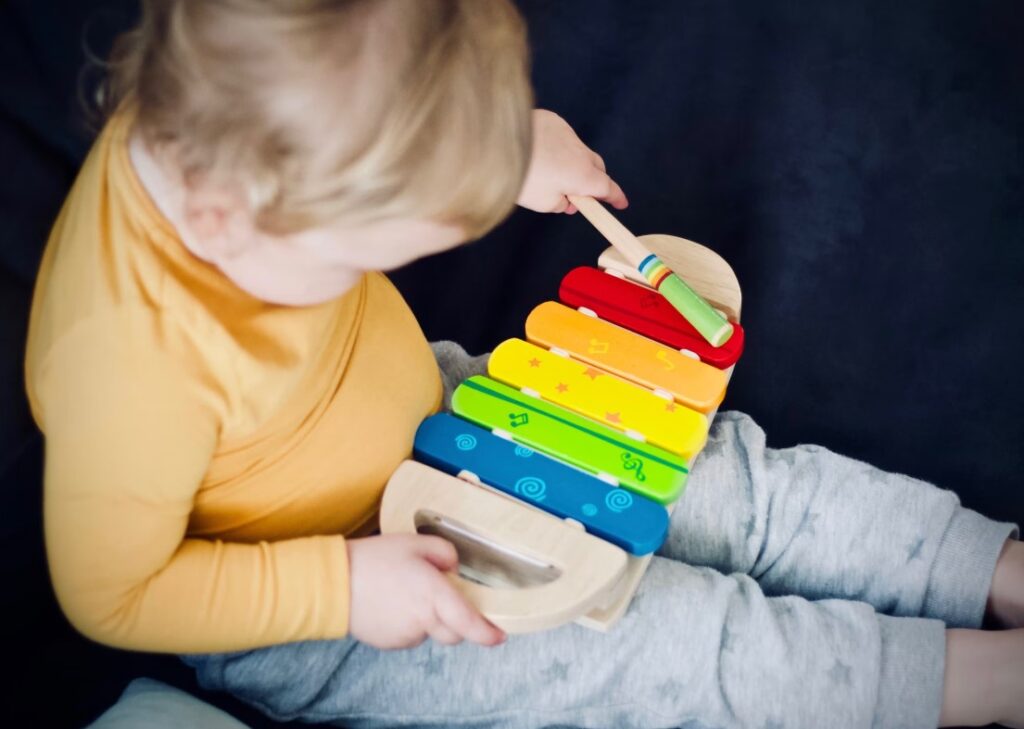
Montessori music instruments: Nurturing a child’s ear for sound
A child’s first exposure to music doesn’t come from an instrument. It comes from the most natural and powerful one of all: the human voice. That’s why singing plays a central role in Montessori music education. But beyond the voice, Montessori environments introduce children to carefully selected instruments that refine their auditory discrimination and sense of pitch.
So, what are Montessori music instruments? The answer is simple — any instrument can be a Montessori instrument as long as it fosters learning and exploration. However, two instruments hold a special place in the Montessori classroom: Montessori bells and tone bars. These Montessori materials are not just tools for making music; they are essential in helping children develop ear training, pitch recognition, and musical literacy.
Let’s explore how these instruments are used in Montessori education and why they are so effective.
The first instrument: The voice
Have you ever noticed how a child naturally starts humming or singing to themselves? This is their way of processing sound and rhythm. Montessori educators encourage this by integrating songs into daily routines — greeting songs, transition songs, and movement songs. Singing in Montessori music education helps children:
- Develop pitch recognition by matching tones and melodies.
- Strengthen language skills through songs, rhymes, and chants.
- Build emotional expression and confidence in their own musical abilities.
But singing alone is not enough. To fine-tune a child’s auditory discrimination, Montessori introduces a structured way to explore pitch: Montessori bells and tone bars.
Montessori bells: The foundation of musical learning
Imagine a child entering a Montessori classroom, drawn to a row of beautifully crafted bells. Each bell produces a different pitch, and without any instructions, the child starts ringing them, curious about how each sound differs.
This is Montessori bells — one of the most iconic Montessori music instruments. They consist of a set of matching pairs of bells, each producing a different pitch. Being visually identical, these bells sound distinct, helping children train their ears to recognize differences in tone.
Montessori tone bars: A bridge to instrumental music
Once children have mastered the bells, they are introduced to Montessori tone bars. These resemble a xylophone but have removable bars, allowing children to physically manipulate the notes and visually understand pitch relationships.
Montessori tone bars help children learn about scales, intervals, and melody through hands-on exploration. They also prepare children for playing other instruments by reinforcing an understanding of musical pitch and sequence.
Other Montessori music instruments
While bells and tone bars are unique to Montessori classrooms, children also explore a variety of traditional music instruments that encourage hands-on learning:
- Xylophones and glockenspiels: Help children see and hear pitch relationships clearly.
- Rhythm sticks and drums: Enhance coordination and teach rhythm through movement.
- Shakers and tambourines: Allow even the youngest children to participate in music-making.
- Wind instruments (such as wooden flutes): Support breath control and fine motor skills.
So, how can you bring Montessori music into your home or classroom? It’s simple: sing often, provide real instruments, and encourage exploration. Music is not about being perfect — it’s about discovering joy through sound. But if you need a more structured approach, Montessori music curriculum is under your disposal.
Montessori music curriculum: A structured approach
As you can see, Music can become an essential part of a child’s development, and the Montessori music curriculum provides a structured yet flexible approach that allows children to explore rhythm, melody, and notation.
Unlike traditional music lessons that focus on memorization and repetition, Montessori music education is hands-on, sensory-driven, and deeply engaging. It introduces children to sound, movement, and musical literacy in a way that feels like play — but with powerful learning outcomes.
Let’s explore the three pillars of the Montessori music curriculum and how they help children develop a lifelong love for music.
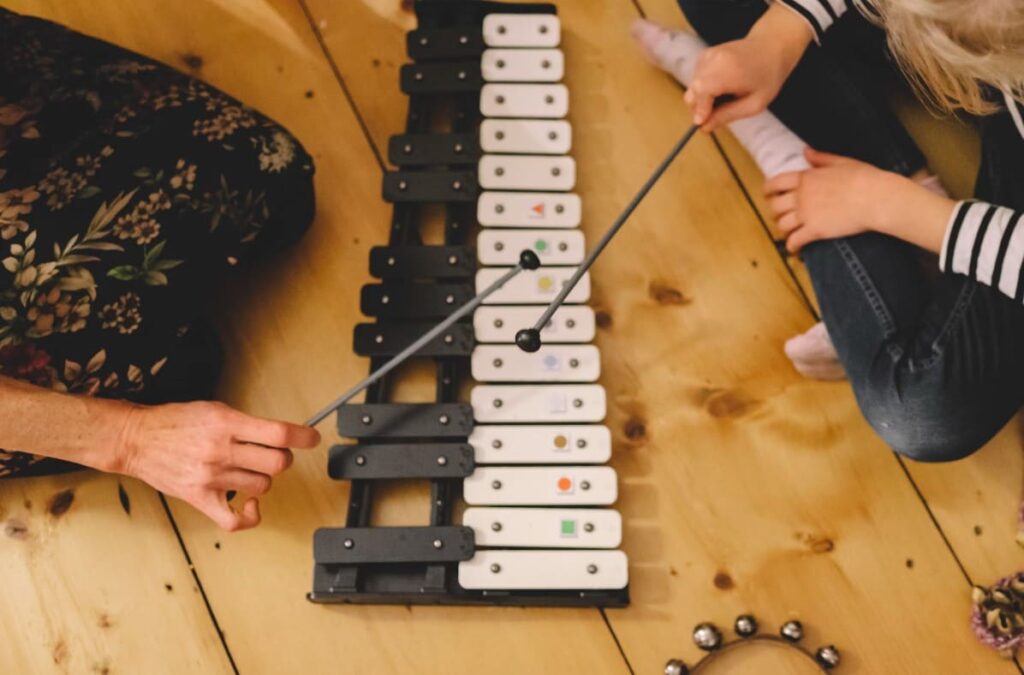
The foundation of auditory discrimination
Before a child can sing in tune, play an instrument, or read music, they need to develop a trained ear. That’s why the Montessori music curriculum involves bells and tone bars. These tools help children build auditory discrimination and pitch recognition.
Montessori bells, for instance, are introduced in multiple different ways:
- First exploration: Children are invited to explore the bells freely, ringing them and listening to the different sounds they produce.
- Matching sounds: The next step is to match bells with identical pitches, refining auditory discrimination.
- Grading by pitch: Children arrange bells from lowest to highest pitch, learning to recognize musical scales.
- Naming notes: Older children begin to associate the bells with musical notation, laying the foundation for music literacy.
- Playing simple melodies: Once they have mastered pitch recognition, children start playing simple songs, developing a sense of rhythm and melody.
This step-by-step progression ensures that children develop a strong musical ear before they even begin formal instruction.
Once children master the bells, they are introduced to Montessori tone bars, which are similar to xylophones but provide a more refined way to explore pitch relationships.
With tone bars, children:
- Arrange the bars to visualize pitch differences.
- Experiment with scales, melodies, and harmonies.
- Learn to play simple songs and explore rhythm patterns.
These practices can help children develop a strong sense of pitch and musical structure in a fun and engaging way.
Movement and dance in Montessori: Learning music through the body
Music isn’t just something we hear — it’s something we feel. That’s why the Montessori music curriculum emphasizes movement as a key part of musical learning.
Think about a baby bouncing to the beat of a song or a toddler clapping along to a rhythm. These movements aren’t random — they’re a child’s natural way of processing music.
Montessori builds on this instinct by incorporating movement and dance into music education. Here’s how:
- Walking the beat – Children walk to the rhythm of a drum or a simple song, internalizing the concept of tempo.
- Clapping and tapping rhythms – Using hands, feet, or rhythm sticks, children learn to feel and replicate beats.
- Dancing to express music – Simple, natural dance movements help children connect emotionally with music.
When children move their bodies in response to sound, they develop a deeper understanding of rhythm, timing, and coordination. It also enhances focus, memory, and creativity, making music an immersive, whole-body experience.
Introduction to notation: Making music a language children can read
Reading music can feel intimidating, even for adults. But in Montessori education, musical notation is introduced just like reading and writing — through gradual exposure, hands-on experiences, and self-discovery.
Below, you can see how Montessori teaches music notation:
- Listening before reading – Children first develop a strong ear for music through singing, playing bells, and moving to rhythm.
- Matching sounds to symbols – They learn to associate high and low sounds with visual symbols before formal note-reading.
- Tracing and drawing Notes – Just like tracing letters in Montessori language materials, children begin drawing simple music notes.
- Reading and playing simple melodies – With time, they recognize musical patterns, making it easier to play and even compose their own tunes.
In the Montessori music curriculum, music is treated as a language — one that children learn naturally through immersion, play, and hands-on exploration. Ready to introduce the joy of Montessori music to your child? Let’s dive into age-appropriate activities that nurture their musical journey.
Montessori music activities for different ages
Below, we explore how Montessori music activities for babies, toddlers, and preschoolers can help nurture a love for music at every stage of development.
Babies (0–12 months): The first musical explorations
Did you know that babies recognize melodies even before birth? Their sense of hearing develops in the womb, making music a natural part of their early experiences. The Montessori approach to music for babies focuses on creating a calm, sensory-rich environment filled with simple rhythms and natural sounds.
Rhythmic sounds and lullabies: Introducing babies to steady beats
Babies love patterns, and rhythm is one of the most powerful patterns they experience. Simple, repetitive sounds soothe, engage, and build early listening skills. Here’s how to introduce rhythm the Montessori way:
- Sing Softly – Your voice is the most comforting sound to your baby. Simple, repetitive lullabies or nursery rhymes provide auditory consistency and emotional security.
- Rock to the Beat – Hold your baby and gently sway or pat their back to the rhythm of a song. This helps them internalize steady beats.
- Use a Heartbeat Drum – A drum mimicking the sound of a heartbeat helps babies feel the natural rhythm they knew before birth.
Musical sensory baskets: Hands-on sound exploration
Another step is musical sensory baskets. You can create one by placing a few musical objects in a small basket. Let your baby explore them one at a time — this prevents overstimulation and encourages focused listening. Babies learn by touching, grabbing, and shaking objects, and Montessori sensory baskets, filled with musical items, introduce them to different textures and sounds.
- Wooden rattles and soft bells – Provide babies with gentle, natural-sounding instruments to explore sound.
- Crinkle fabric and shakers – Soft, textured materials that make noise encourage grasping and fine motor development.
- Rainsticks and chimes – The soothing sounds of falling beads or wind chimes help babies develop auditory focus.
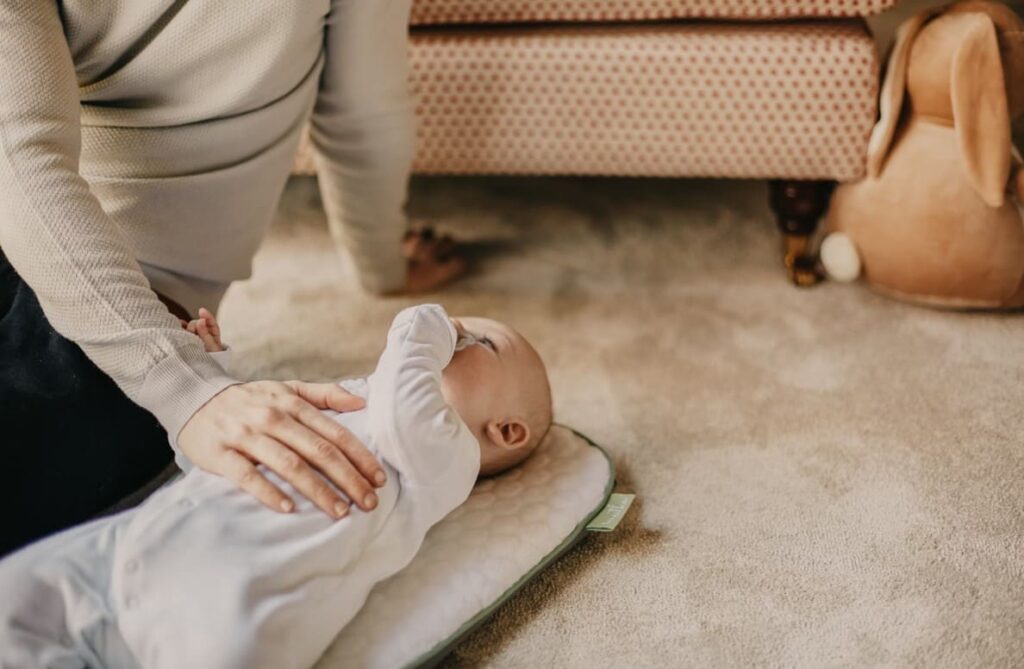
Toddlers (1–3 years): Making music through movement
Toddlers are always on the move, and their music activities should be, too! At this stage, music becomes more interactive — children begin clapping, dancing, and experimenting with their voices. The goal is to build rhythm, coordination, and early musical memory.
Clapping games and simple rhythm patterns
Rhythm is the foundation of all music, and toddlers love making beats! These activities help improve their sense of timing and coordination:
👏 Clap and copy – Clap a simple rhythm and encourage your toddler to repeat it back.
👣 Stomp the beat – Walk, stomp, or march in time with a drumbeat. This strengthens gross motor skills and musical awareness.
🎤 Echo singing – Sing short phrases and let your toddler echo them back. This introduces pitch-matching and tonal variation.
Singing and repeating melodies: Building early musical memory
Toddlers love repetition — it helps them learn! Singing familiar songs over and over builds musical recognition, memory, and confidence.
- Call-and-response songs – Songs like Row, Row, Row Your Boat or If You’re Happy and You Know It encourage toddlers to participate in music-making.
- Singing with hand motions – Songs with gestures (Twinkle, Twinkle Little Star) help with motor coordination.
- Silly Voice Changes – Singing in high, low, fast, or slow voices teaches toddlers about pitch and tempo.
DIY musical instruments: Encouraging creativity
Music doesn’t have to come from store-bought instruments! Montessori encourages using natural materials to create sound.
- Homemade maracas – Fill a small, sealed container with beans or rice and let your toddler shake it.
- Wooden spoon drums – Give your child a wooden spoon and a sturdy surface to tap on different objects and explore sounds.
- Rubber band guitars – Stretch rubber bands across an empty box to let your toddler plunk out rhythms.
Preschoolers (3–6 years): Discovering instruments and music literacy
Preschoolers are ready to dive deeper into music. Their listening skills are stronger, their hands are more coordinated, and they begin understanding musical patterns and relationships.
Introduction to simple instruments
At this stage, children can begin playing real instruments in a structured way:
🔔 Bells and tone bars – Develop ear training and pitch recognition
🎶 Xylophones and glockenspiels – Help children understand pitch progression and play simple tunes.
🥁 Tambourines and drums – Develop rhythm skills through call-and-response drumming.
🎺 Wooden flutes – Encourage breath control and fine motor coordination.
Movement-based music: Dancing and rhythm games
Music and movement go hand in hand. Montessori classrooms integrate:
💃 Rhythm-based dancing – Children move their bodies to different tempos and beats.
🕺 Musical statues – Dancing stops when the music pauses, teaching listening skills.
🎭 Storytelling with music – Using sound effects and melodies to enhance imagination.
From the gentle lullabies of infancy to the structured melodies of preschool, Montessori music activities evolve alongside a child’s natural development. Whether through clapping games, homemade instruments, or Montessori Bells, music becomes a joyful experience that is never forced but always explored.
Scientific evidence: Why playing instruments and singing benefits children
We’ve already mentioned above that research consistently shows that playing musical instruments and singing enhance cognitive, social, and emotional skills, making music a critical component of early childhood education. Let’s explore the topic in more detail.
Brain connectivity and plasticity
Studies have shown that learning music increases neural connectivity by enhancing the density of white matter in the corpus callosum, the part of the brain responsible for communication between hemispheres. This improved connectivity enhances problem-solving, logical thinking, and overall cognitive function.
Additionally, music strengthens brain plasticity, the brain’s ability to reorganize and form new neural connections. Research from the University of Southern California’s Brain and Creativity Institute found that early exposure to music accelerates auditory system development, enhancing language processing and decision-making skills.
Memory, focus, and learning abilities
Playing an instrument requires intense focus, boosting working memory and attention span. A study published in Psychological Science found that children with musical training significantly outperformed their peers in memory and problem-solving tasks.
Music also enhances overall memory retention, with research showing that children who engage with music recall information more effectively and develop stronger learning habits.
Communication and language skills
The ability to process, interpret, and express information is deeply influenced by musical training. Studies confirm that music strengthens language development, as it enhances phonemic awareness, listening comprehension, and verbal communication skills.
Beyond spoken language, playing instruments and singing enhance non-verbal communication, helping children express emotions, engage in social interactions, and build confidence in their interactions with others.
Academic success and coordination
Musical training doesn’t just improve artistic abilities — it directly contributes to better academic performance. Studies indicate that children who participate in music education score higher in reading, math, and critical thinking skills compared to their non-musical peers.
Additionally, playing an instrument enhances hand-eye coordination by requiring precise movements that synchronize with auditory cues. Research highlights that this improved motor control extends to writing, sports, and other fine motor activities.
Social and emotional development
Engaging in musical activities, especially in group settings, strengthens social skills by encouraging cooperation, patience, and teamwork. Children who participate in music education demonstrate greater empathy and stronger social bonds.
At an emotional level, music training has been linked to higher emotional intelligence, helping children recognize, process, and regulate their emotions more effectively.
Furthermore, music enhances creativity and confidence, giving children a space to experiment, take risks, and develop self-expression in a natural, supportive environment.
The scientific evidence of the positive impact of playing musical instruments and singing for children is overwhelming. Music not only strengthens cognitive abilities, memory, and language skills but also fosters social, emotional, and creative growth. The Montessori music curriculum ensures that children develop a lifelong love for music while enhancing their overall development.
Conclusion: Why every child should experience Montessori music
Music is a universal language that nurtures the whole child — mind, body, and emotions. It plays a key role in cognitive growth, emotional development, and physical coordination. Singing strengthens auditory skills and language learning, playing Montessori music instruments like bells and rhythm sticks enhances motor skills, and movement-based activities help children internalize rhythm naturally.
Incorporating Montessori music activities at home or in the classroom is simple. Sing throughout the day, introduce rhythm games, and provide real, high-quality instruments like xylophones or tambourines for hands-on exploration. Music is not about performance but about self-expression, creativity, and joy — a gift that stays with children for life.
Are you ready to bring the power of music into your child’s learning journey? Give your child the opportunity to explore music the Montessori way. Visit the Montessori Family Center to discover resources, guidance, and instruments that help children engage with music from the very start. Curious about what comes next? Discover other subjects your child will experience in this guide to the Montessori curriculum.
FAQ: Montessori music education – Everything you need to know
1. What is Montessori music education?
Montessori music education is a child-centered approach that integrates music into daily learning through exploration, movement, and hands-on engagement. Instead of rigid lessons, children interact with instruments, experiment with sounds, and develop rhythm and pitch recognition naturally.
2. How does music fit into the Montessori curriculum?
Music in Montessori is treated as a sensorial experience, much like language and math. Children explore rhythm, melody, and musical notation through singing, movement, and Montessori music instruments like bells and tone bars.
3. What are the benefits of Montessori music education?
Montessori music enhances cognitive, emotional, and physical development by improving memory, language skills, coordination, and social interaction. It also fosters independence and creativity, allowing children to explore music at their own pace.
4. What are the best Montessori music instruments for young children?
Some of the most effective Montessori music instruments include: Montessori bells for pitch recognition, rhythm sticks and drums for beat awareness, xylophones and glockenspiels for melody and scale introduction, and wooden flutes for breath control and fine motor development.
5. How does music improve cognitive development in children?
Studies show that learning music strengthens neural connections, boosts working memory, and enhances problem-solving skills. It also improves language development, mathematical thinking, and academic performance.
6. What is the role of singing in Montessori music education?
Singing is a child’s first musical instrument. In Montessori, it helps develop language skills, emotional expression, and pitch recognition. Songs are often used in daily routines, storytelling, and group activities to encourage social interaction.
7. How can parents introduce Montessori music at home?
Parents can create a musical environment by singing regularly, providing real instruments like bells and drums, encouraging movement-based music activities, and using Montessori-inspired games to explore rhythm and melody.
8. Is there scientific evidence supporting the benefits of music for children?
Yes, research confirms that playing musical instruments and singing enhances brain connectivity, boosts memory and learning abilities, and improves communication and social skills.
9. How does movement support music learning in Montessori?
Music and movement go hand in hand in Montessori. Activities like clapping, marching, and dancing help children internalize rhythm, develop coordination, and improve listening skills, making music an immersive experience.
10. Where can I find Montessori music resources and materials?
You can find Montessori music instruments, lesson plans, and activity guides at reputable Montessori education websites and learning centers. Visit the Montessori Family Center for expert guidance on integrating music into your child’s development.
References and further reading
For a deeper understanding of Montessori music education, its principles, and its impact on child development, explore these expert resources:
- The Montessori Notebook: An insightful guide on how music is integrated into the Montessori method, emphasizing sensory exploration, movement, and child-led discovery.
- Hollis Montessori School: A detailed article on the role of music in Montessori education, exploring how rhythm, singing, and instrument play support a child’s development.
- American Montessori Society discusses the importance of movement-based learning and how music enhances cognitive, emotional, and motor skills in Montessori environments.
- Montessori Services: Practical insights on incorporating Montessori music activities in daily learning, along with suggestions for instruments and teaching methods.
- AMI USA: A comprehensive resource covering the Montessori music curriculum, including Montessori bells, tone bars, and strategies for fostering musical literacy.
These resources provide valuable perspectives on how music supports a child’s intellectual, emotional, and physical growth within a Montessori framework.