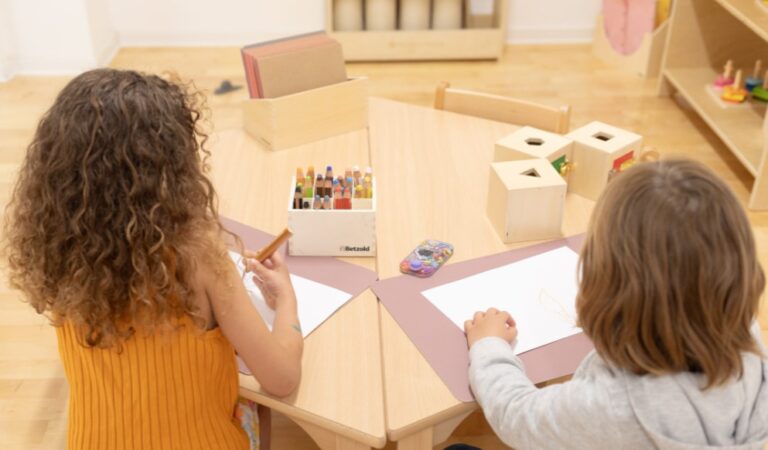
Table of Contents
- What is bilingual Montessori education?
- Benefits of bilingual Montessori education
- Myths vs. reality: Speech delays and confusion
- How to raise bilingual children: 4 practical models
- Montessori activities for bilingual learning at home
- Final Words: Language, mind, and lifelong learning
- Bilingual Montessori FAQ
Imagine watching your child seamlessly switch between English and German while playing, or confidently ordering a pastry in French during a family vacation. For many parents, the ability to speak a second language is one of the greatest gifts they can offer their children — a passport to global connection, cognitive resilience, and cultural empathy. But the path to getting there often feels riddled with questions: Will they be confused? Is it too much pressure? What is the best way to raise bilingual children without forcing it?
The answer often lies in a method that has respected the child’s natural development for over a century. Bilingual Montessori is an educational approach that fuses the immersion of dual-language learning with Maria Montessori’s “prepared environment.” In a bilingual Montessori school or at home, language isn’t taught through rote drills; it is lived. Children absorb a second language just as they did their first — through sensory exploration, social interaction, and hands-on discovery.
This guide is your roadmap. Below, we explore how to raise bilingual children by combining the proven principles of Montessori education with the latest insights from neuroscience. From debunking myths about speech delay in bilingual children to practical strategies for your home, you will discover why this method is uniquely suited to unlocking your child’s linguistic potential.
What is bilingual Montessori education?
Bilingual Montessori education is not simply a standard curriculum with a foreign language added on top. It is a deliberate fusion of the “Prepared Environment” with natural, immersive language exposure. In this model, language is never treated as an isolated academic subject or a scheduled 30-minute lesson. Instead, two languages are woven into the fabric of the child’s daily reality.
In a bilingual Montessori school, language serves a functional purpose. When a child pours water, scrubs a table, or solves a math problem, they hear and use language relevant to that specific action. This context is crucial: vocabulary is anchored to meaning and experience rather than abstract memorization. The child learns leche or lait not by looking at a flashcard, but by pouring the milk.
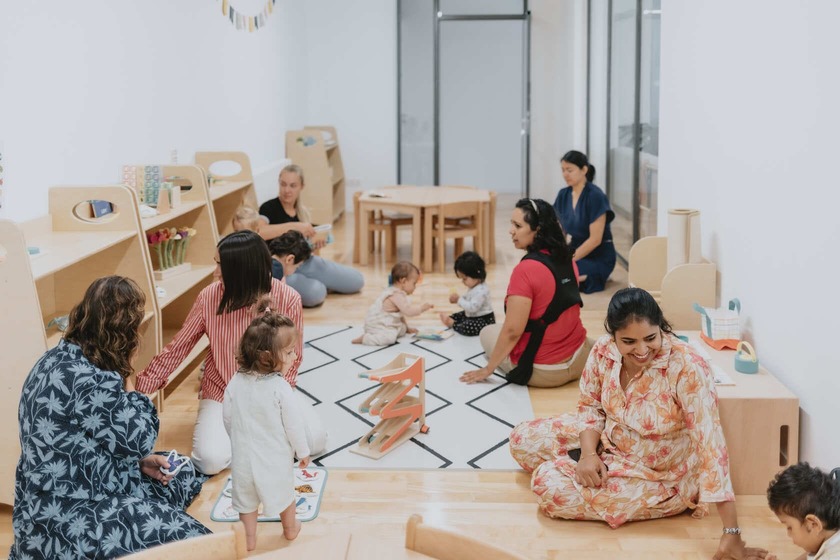
Mixed-age classrooms as a language engine
Montessori schools utilize mixed-age classrooms (typically spanning three-year cycles, such as ages 3–6) to create a dynamic social structure. This setup acts as a powerful catalyst for language development:
- Observation: Younger children absorb complex sentence structures and vocabulary simply by watching and listening to older peers interact.
- Reinforcement: Older children solidify their own fluency by modeling language and helping younger classmates, a process that requires them to articulate thoughts clearly.
- Motivation: Language becomes a social necessity rather than a performance. Children speak to be understood by their friends, creating a natural, low-pressure feedback loop.
The Montessori philosophy as the best way to raise bilingual children
The core principles of the Montessori method align perfectly with the cognitive requirements of bilingualism, offering a distinct advantage over traditional education:
- Child-led learning: Children select work that matches their developmental readiness. This autonomy lowers anxiety (the “affective filter”), allowing the second language to emerge naturally without the pressure of forced output.
- Hands-on materials: Concrete objects provide physical context for new words. Holding a geometric solid while hearing its name in a second language creates a dual memory trace — sensory and linguistic — enhancing retention.
- Sensitive periods: The curriculum is designed to respect specific developmental windows when children are biologically primed to detect sound and meaning.
Unlike traditional methods that rely on rote memorization and direct correction, this approach prioritizes acquisition over instruction. Children do not memorize lists; they inhabit the language. This immersive, sensory-rich context is widely considered the best way to raise bilingual children, as it mirrors the natural way humans learn their mother tongue: through movement, purpose, and connection.
The “Absorbent Mind” and language acquisition
Maria Montessori identified the first six years of life as the period of the “Absorbent Mind” — a unique cognitive state where children soak up information from their surroundings without conscious effort. Modern neuroscience validates this, showing that the neuroplasticity of the young brain makes it exceptionally sensitive to linguistic inputs.
Between birth and age six, the brain is primed to internalize:
- Phonetic distinctions (the specific sounds of a language)
- Rhythm, tone, and intonation
- Grammatical patterns and syntax
Why does this matter for raising bilingual children? Let’s take a look at the benefits.
Benefits of bilingual Montessori education
While the Montessori philosophy provides the method for natural learning, modern science provides the evidence for its impact. But is the additional effort of dual-language education really worth it?
Across neuroscience, psychology, and education research, the answer is clear: the benefits of bilingual education extend far beyond knowing two vocabularies.
When a prepared Montessori environment is combined with early bilingual exposure, the result is not just language proficiency, but a distinct developmental advantage that shapes how children think, focus, learn, and relate to others — both academically and socially. Below, you will find a list of the benefits of bilingual education.
Benefits of bilingual Montessori education — Aggregated overview
| Benefit | Short description |
| Executive function strength | Bilingual children show stronger attention control, task switching, and self-regulation due to managing two active language systems. |
| Improved inhibitory control | Regularly suppressing one language while using another trains the brain to ignore distractions and focus more effectively. |
| Cognitive flexibility | Switching between languages enhances mental adaptability, helping children adjust to new rules, perspectives, and problem-solving strategies. |
| Advanced problem-solving skills | Bilingual children often perform better on non-verbal reasoning tasks that require flexible thinking and rule changes. |
| Enhanced working memory | Managing multiple linguistic systems strengthens the ability to hold and manipulate information in mind. |
| Metalinguistic awareness | Bilingual children develop an early understanding that words are symbols, supporting stronger reading and literacy skills. |
| Earlier perspective-taking (theory of mind) | Bilingualism improves the ability to understand others’ thoughts, beliefs, and intentions through constant language-context evaluation. |
| Greater social empathy | Regularly adjusting language for different people fosters emotional sensitivity and social awareness. |
| Stronger listening skills | Exposure to multiple languages enhances attention to tone, context, and meaning in communication. |
| Natural pronunciation acquisition | Early bilingual exposure during sensitive periods supports native-like accent development without formal instruction. |
| No increased risk of speech delay | Research shows bilingualism does not cause speech or language delays when development is assessed across both languages. |
| Normalized code-switching | Mixing languages is a typical developmental strategy, not confusion, and reflects linguistic resourcefulness. |
| Total vocabulary parity | When both languages are counted, bilingual children’s total conceptual vocabulary matches monolingual peers. |
| Academic readiness | Executive function and metalinguistic skills support early literacy, math reasoning, and classroom learning. |
| Better learning transfer | Skills developed in one language (especially meaning-based skills) support learning in the other through cross-language transfer. |
| Cultural identity development | Maintaining multiple languages strengthens connection to family heritage and cultural belonging. |
| Emotional security | Children communicate more fully with extended family and community, supporting emotional stability and confidence. |
| Global competence | Early bilingualism builds comfort navigating diverse linguistic and cultural environments. |
| Long-term cognitive resilience | Lifelong bilingualism is associated with cognitive reserve and delayed age-related cognitive decline. |
| Motivation through meaning | Language learned through real Montessori work is tied to purpose and action, increasing intrinsic motivation. |
| Peer-driven language growth | Mixed-age Montessori classrooms amplify language learning through observation, modeling, and explanation. |
| Reduced academic pressure | Language acquisition occurs naturally through activity rather than memorization, lowering performance stress. |
| Stronger self-confidence | Mastery of communication across languages reinforces autonomy and self-trust. |
| Alignment with sensitive periods | Montessori environments capitalize on early neurological windows when language absorption is most efficient. |
| Whole-child development | The combination of bilingualism and Montessori supports cognitive, social, emotional, and cultural growth simultaneously. |
Cognitive benefits — Are bilingual children smarter?
One of the most common questions parents ask is whether bilingual children are smarter. The answer, however, requires nuance. Research consistently shows that bilingualism does not increase raw IQ scores. However, it does make the brain more efficient, flexible, and resilient.
When a child navigates two languages, the brain is constantly managing competition between linguistic systems. This strengthens a core cognitive mechanism known as inhibitory control — the ability to suppress irrelevant information and focus on what matters.
This “mental workout” enhances executive function, the brain’s command center responsible for attention regulation, planning, task switching, and self-control.
Executive function and attention control
Multiple studies show that bilingual children outperform monolingual peers on tasks requiring selective attention and conflict resolution. A widely cited NIH-hosted review demonstrates that bilingual experience strengthens executive control networks, allowing children to filter distractions and switch tasks more efficiently.
In a Montessori setting — where children independently choose work, sustain concentration, and self-correct — these executive advantages are continuously reinforced.
Cognitive flexibility and problem solving
Because bilingual children routinely switch between linguistic systems, they develop stronger cognitive flexibility — the ability to adapt to new rules, perspectives, or problem-solving strategies.
This advantage transfers beyond language. A comprehensive review shows that bilingual children perform better on non-verbal reasoning tasks and rule-switching games, reflecting enhanced mental agility.
Montessori materials further amplify this benefit by requiring children to approach problems concretely, abstractly, and independently.
Memory, focus, and long-term brain health
Research also links bilingualism to improvements in working memory and sustained attention. Over time, managing two active languages contributes to cognitive reserve. The latter has been associated with the delayed onset of age-related cognitive decline later in life — a long-term benefit that begins in early childhood.
Academic and social advantages
The benefits of raising bilingual children within a Montessori framework extend well beyond cognition, influencing literacy, communication, and emotional intelligence.
Metalinguistic awareness and literacy
Bilingual children develop metalinguistic awareness — an understanding of how language itself works — earlier than monolingual peers. They recognize that words are symbols and that meaning can be expressed in multiple ways.
This insight often translates into stronger early reading skills and improved literacy across both languages. A foundational study on bilingualism and metalinguistic development demonstrates this advantage clearly.
In Montessori classrooms, where reading and writing emerge organically through phonetic materials and self-paced exploration, this awareness becomes a powerful academic asset.
Social cognition and empathy (theory of mind)
One of the most profound — and often overlooked — benefits of bilingualism is its impact on social cognition.
Bilingual children regularly evaluate who understands which language and adjust their communication accordingly. This constant perspective-taking strengthens Theory of Mind — the ability to understand that others have different beliefs, knowledge, and viewpoints.
A study published in Psychological Science found that bilingual children consistently outperform monolingual peers on Theory of Mind tasks, demonstrating greater social awareness and empathy.
Montessori’s emphasis on mixed-age classrooms, peer collaboration, and respectful communication further deepens this capacity.
Cultural identity and emotional connection
Bilingual Montessori education also supports identity formation and emotional security. Language is a part of family, culture, and belonging. When children use more than one language naturally, they are better able to connect with extended family, cultural traditions, and diverse communities.
This strengthens confidence, reduces social anxiety in multicultural settings, and fosters openness toward difference — a critical skill in an increasingly global world.
Beyond language — A whole-child advantage
The evidence is consistent across disciplines: bilingual Montessori education does not simply teach children what to think or how to speak. It shapes how the brain organizes information, regulates attention, solves problems, and understands others.
By choosing a bilingual Montessori path, families are not just investing in language acquisition. They are supporting the development of a focused, adaptable, and empathetic mind — one that is prepared not only for school, but for life.
Myths vs. reality: Speech delays and confusion
When parents decide to raise a child with two languages, they often face well-meaning but misguided warnings from relatives or even some educators: “They will get confused!” or “They won’t speak until they are three.”
It is crucial to separate anecdotal fear from scientific fact. In a bilingual Montessori environment, we observe that children are not confused; they are simply managing a more complex cognitive task. Let’s look at the reality behind the most common myths.
Do bilingual children talk later?
The Short Answer: No — but their development can look different at first.
One of the most persistent concerns is whether bilingual children are delayed in speech. The research-based answer is a definitive no. Bilingualism itself does not cause speech or language delays.
Where confusion often arises is in how parents measure the vocabulary.
- A bilingual child may initially know fewer words in each language compared to a monolingual peer.
- However, when you consider both languages together, the child’s “Total Conceptual Vocabulary” is equal to or often greater than that of monolingual children.
Consider the “Conceptual” Difference. For example, if a child knows “dog” in English and “perro” in Spanish, they understand the concept of the animal twice. Standard tests might count this as “1 word in English” (seeming behind), but a conceptual count recognizes they possess 2 words’ worth of linguistic knowledge.
What looks like a delay is usually a “measurement artifact,” not a developmental problem. In Montessori environments, where language is embedded in action (e.g., washing hands while hearing “soap/jabón”), this temporary imbalance typically resolves naturally as exposure continues.
The truth about code-mixing
Mixing languages (also known as code-mixing) is not confusion — it is competence.
Another common myth is that when a child uses two languages in the same sentence (e.g., “I want más juice”), they are confused. Linguistic research and Montessori educators agree on the opposite: code-mixing is a sign of linguistic sophistication.
Code-mixing occurs because:
- High Brain Activity: Both languages are active in the brain simultaneously.
- Efficiency: The child selects the most accessible or specific word available to them in that moment.
- Grammar Retention: Even when mixing words, children rarely violate the grammatical rules of the sentence structure.
As a parent, you should react as follows:
- ✅ Accept the message: Respond to what the child is saying, not how they said it.
- ✅ Model naturally: If they say, “I want más juice,” you can reply, “Here is more juice” or “Aquí hay más jugo.”
- ❌ Avoid correction: Do not pressure them to “pick one language.”
In a bilingual Montessori classroom, teachers do not correct code-mixing. They understand it is a temporary bridge to fluency. As the child’s vocabulary depth increases in both languages, the mixing naturally fades.
Bottom line for parents: Monolingual vs. bilingual milestones
If you are still worried about your child’s progress, compare their development against this timeline. You will see that the critical milestones remain the same regardless of how many languages are spoken:
| Developmental stage | Monolingual timeline | Bilingual timeline | What to expect |
| Babbling | 6–10 Months | 6–10 Months | Bilingual babies babble at the same age. You may hear sounds from both languages. |
| First Words | 11–14 Months | 11–14 Months | The first word may be in either language (or one word from each!). |
| Two-Word Phrases | 18–24 Months | 18–24 Months | Phrases may mix languages (“More leche”), which is developmentally normal. |
| Vocabulary Explosion | 18–30 Months | 18–30 Months | Total vocabulary grows rapidly, though it is distributed across two languages. |
So, let’s summarize the key aspects:
- Bilingualism does not cause speech delay.
- Bilingual children do not talk later in a clinically meaningful way.
- Language mixing is normal, expected, and healthy.
Understanding these realities allows you to move past fear-based myths. If you are asking, “Are bilingual children delayed in speech?”, rest assured! While they are taking a different scenic route, they arrive at the same destination — often with more luggage! But how to let children get to this destination most pleasantly?
How to raise bilingual children: 4 practical models
There is no single “right” way to raise a bilingual child, but there is one golden rule: consistency. Whether you are fluent in two languages or learning alongside your child, the best way to raise bilingual children is to choose a strategy that fits your family’s lifestyle and stick to it.
Below are the four most successful models.
1. One parent, one language (OPOL)
This is perhaps the most famous method. As the name suggests, each parent speaks exclusively to the child in their own native (or dominant) language. For example, the mother might speak only German while the father speaks only English. This creates a clear boundary for the child, helping them associate specific languages with specific people.
- Best For: Families where parents have different native languages and want to ensure equal exposure to both.
- Pros: High clarity for the child; reduces mixing.
- Cons: Requires strict discipline from parents; can be challenging if one parent spends significantly less time with the child.
2. Minority language at home (ML@H)
In this model, the family speaks the “minority” language (the one not spoken in the wider community) exclusively inside the home. The “majority” language is acquired through school, playgrounds, and the outside world. For instance, a family living in Germany might speak only English at home, knowing the child will inevitably learn German from their environment.
- Best For: Expat families, immigrant families, or those with strong heritage language goals.
- Pros: Guarantees strong exposure to the weaker language.
- Cons: Can feel isolating for guests who do not speak the home language.
3. Contextual / time & place routining
This model links language to a specific time, place, or activity rather than a person. You might decide, “We speak English on weekends,” “Bath time is always in French,” or “We only speak German at the dinner table.” This provides structure without requiring one parent to remain in “teacher mode” 24/7.
- Best For: Single-parent households, parents who are not native speakers but are learning alongside the child, or families who want a lower-pressure approach.
- Pros: Flexible; allows parents to learn with the child.
- Cons: Requires commitment to the schedule; less total exposure time than OPOL.
4. Full immersion (The bilingual Montessori school)
In this model, the child receives their second language exposure primarily through their educational environment. A high-quality bilingual Montessori program creates a “micro-society” where the target language is the primary tool for communication, work, and play for 6–8 hours a day.
- Best For: Monolingual parents who cannot teach a second language themselves but want the benefits for their child.
- Pros: Professional instruction; peer immersion; exposure during the “Absorbent Mind” phase.
- Cons: Requires finding a high-quality program; parents must support the school (e.g., through books or music) to maintain fluency during breaks.
Success Tip: Many families combine models. For example, you might use ML@H while sending your child to a bilingual Montessori school that reinforces that same language, creating a powerful “double dose” of exposure.
Montessori activities for bilingual learning at home
You do not need to be a trained teacher — or recreate a classroom — to bring the benefits of bilingual Montessori into your home. In fact, Montessori at home works best when it feels lived in, not instructional. The goal is not to “teach a language,” but to design an environment where language emerges naturally through daily life.
By making small, intentional changes to your space and routines, you can support bilingual development, whether your child attends a bilingual Montessori school or you are introducing a second language at home for the first time.
The prepared environment at home
In Montessori, the prepared environment supports independence, order, and exploration. For bilingual children, it also provides linguistic anchors — clear, consistent cues that connect words to the real world.
Bilingual labeling
A simple and highly effective strategy is to label everyday objects at your child’s eye level.
- Use index cards or simple tags with clear printed text in both languages
- Examples: lamp / lámpara, chair / chaise, door / puerta
- Keep fonts clean and readable — no pictures needed at first
This builds early print awareness and helps children understand that objects exist in both linguistic systems, without explanation or instruction.
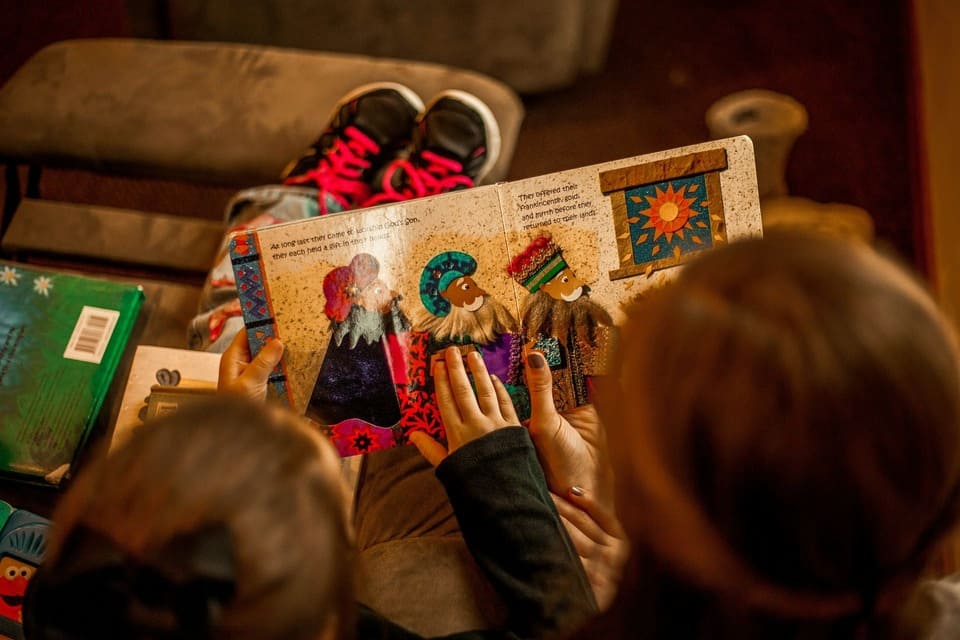
A curated reading corner
Create a cozy, accessible reading space with a low shelf and front-facing books, a classic Montessori design choice.
- Place books in both languages within easy reach
- Choose books with strong visuals and simple, repetitive language
- Make the space inviting, not overwhelming — soft light, a mat or cushion, and freedom to explore independently
The rule of rotation
Resist the urge to display all books at once.
- Offer 4–6 books per language at a time
- Rotate selections every two to three weeks
- Observe which books your child returns to — repetition signals interest and learning
Rotation reduces clutter and keeps language exposure fresh and engaging, without constant novelty.
Visual cues for independence
To help children distinguish languages on their own, add subtle visual markers.
- Use small color dots or stickers on book spines (for example, red for Spanish, blue for English)
- Keep the system consistent but simple
These cues support autonomy and choice, key Montessori values, while reinforcing language awareness.
Sensory and practical life activities
One of the clearest answers to how to raise bilingual children the Montessori way is this: stop teaching and start doing. Montessori practical life activities — real, purposeful tasks — are ideal for language development because they engage the hands, senses, and mind at the same time.
Narrate the action
As your child works, describe what is happening in the target language.
Instead of silently observing dishwashing, you might say:
“Feel the warm water. Look at the bubbles. The sponge is rough. The plate is smooth.”
Why this works: Language becomes tied to physical sensation and movement, a process sometimes called neuro-linguistic binding. Words learned through the body are remembered more deeply than those learned through repetition or flashcards.
Task-based requests
Invite language comprehension through meaningful requests.
- “Please pass me the red towel.”
- “Can you pour the water slowly?”
- “Let’s cut the apple into small pieces.”
These prompts encourage listening and understanding without forcing verbal output. The child participates successfully even before they speak fluently.
Everyday tasks as language lessons
Excellent bilingual Montessori activities include:
- cooking and baking
- folding laundry
- watering plants
- setting the table
- cleaning windows or mirrors
When language is a part of real work, children stay engaged longer and associate speech with purpose, cooperation, and confidence.
Bringing it all together
At home, bilingual Montessori is not about perfection or constant language use. It is about consistency, meaning, and trust.
- Prepare the environment so language is visible and accessible
- Use real-life activities instead of formal lessons
- Model language naturally without pressure or correction
When language is part of daily life, children absorb it the same way they absorb everything else in Montessori: joyfully, effortlessly, and at their own pace.
Final Words: Language, mind, and lifelong learning
Bilingual Montessori offers a rare double advantage: it nurtures deep cognitive development while supporting natural, confident linguistic fluency. By combining the Montessori principles of independence, sensitive periods, and a carefully prepared environment with meaningful exposure to two languages, children are not just learning what to say — they are learning how to think, focus, and connect.
Research consistently shows that this approach supports executive function, attention control, empathy, and flexible problem-solving, while also laying a strong foundation for literacy and communication in more than one language. In other words, bilingual Montessori does not add pressure or complexity — it aligns with how children learn. For families focused on raising bilingual children, this method transforms language from a subject into a lived experience, delivering long-term benefits of bilingual education for children that extend far beyond early childhood.
If you would like to explore how these principles work in real life — from classrooms and parent programs to home-based guidance — we invite you to visit Montessori Family Center. Here, you can learn more about bilingual Montessori opportunities and discover how to support your child’s development with clarity, confidence, and trust.
Bilingual Montessori FAQ
1. What does bilingual mean?
Bilingual means the ability to understand and use two languages. For children, this does not require equal fluency in both languages at all times — it simply means both languages are part of their daily life and development.
2. Do bilingual children talk later?
No. Bilingual children follow the same overall language development timeline as monolingual children. They may initially have fewer words in each language, but their total vocabulary across both languages is comparable, and this difference is not a speech delay.
3. Are bilingual children smarter?
Bilingualism does not increase IQ, but it does strengthen executive function, including attention control, cognitive flexibility, and problem-solving. These skills make the brain more efficient, especially in tasks that require focus and adaptability.
4. How to raise bilingual children?
The most effective approach is consistent, meaningful exposure through daily life. This can include speaking different languages at home, enrolling in a bilingual Montessori environment, reading books in both languages, and using real-life activities rather than formal lessons.
5. Why is it important to be bilingual?
Being bilingual supports cognitive development, cultural awareness, communication skills, and long-term academic and professional opportunities. It also strengthens empathy and the ability to understand different perspectives.
6. Is it too late to start bilingual Montessori at age 4?
No. Montessori identifies a sensitive period for language that lasts until around age six. Starting bilingual Montessori at age four can still be highly effective and developmentally appropriate.
7. Will my child be confused learning two languages at once?
No. Research shows that children can differentiate between languages from birth. Mixing languages at times is normal and reflects learning, not confusion.
8. What if I don’t speak the second language?
You can still support bilingual development through audiobooks, songs, community programs, bilingual Montessori schools, playgroups, and consistent exposure provided by teachers or caregivers.