Have you ever wondered what makes a Montessori classroom so special? Why do so many children seem calm, focused, and joyful in these spaces, even without a teacher lecturing at the front of the room?
At its heart, a Montessori classroom is not just a room with desks and books. It’s a thoughtfully curated space where every object, activity, and layout suits the child. This is known as the “prepared environment” — a term that lies at the core of Montessori philosophy. So, what is a Montessori classroom exactly? Let’s explore it together.
What is a Montessori classroom?
According to the Montessori philosophy, a classroom is a learning environment that meets the needs, interests, abilities, and development of the children in a specific age range.
Instead of one-size-fits-all lessons, a Montessori classroom offers the following features:
- Hands-on learning materials;
- Mixed-age groups;
- Children working independently or in small groups;
- A teacher who guides quietly, rather than commands loudly.
The goal here is not to pour knowledge into children but to support them in discovering it themselves. Such a classroom fosters autonomy and intrinsic motivation. Children choose what they work on, move freely within the space, and care for their surroundings, building not just academic skills, but confidence and responsibility.
Imagine a space where your child is trusted to lead their own learning. That’s what a Montessori classroom is. And here’s what’s truly magical: Montessori classrooms are quiet not because children are silent, but because they’re deeply engaged.
So, whether you’re new to the idea or already enchanted by the Montessori approach, this guide will show you how the classroom is organized, why it works, and how it supports children at every stage of their development — from preschool through school years.
The philosophy behind the Montessori classroom setup
Many people who walk into a Montessori classroom for the first time wonder why everything is so calm, orderly, and inviting. The shelves are low with neatly arranged materials, and the teacher quietly observes rather than leading from the front.
It’s not by accident. It’s by design — and rooted in a deep Montessori classroom philosophy that places the child at the center of everything.

🌿 The prepared environment: A classroom that teaches
In traditional classrooms, the teacher is the focal point. In a Montessori prepared environment, the place itself becomes the teacher.
Dr. Maria Montessori believed that children thrive when they are free to move, choose, and explore within a space designed to meet their developmental needs. That’s why every item in the room has a purpose, every shelf is within reach, and every material is self-correcting.
A Montessori classroom’s structure promotes independence, freedom within limits, and a sense of order, becoming a space where children learn because it is interesting, rather than because someone is forcing them.
Can you imagine how it feels for a child to choose a task, complete it on their own, and return it to its place with pride?
🧭 Freedom within limits — not chaos
Contrary to what some might think, Montessori classrooms are not “free-for-alls.” Their structure is incredible, but at the same time gentle, respectful, and empowering.
Children are free to:
- Choose their work;
- Work alone or with others;
- Move around the classroom;
- Take breaks when needed.
At the same time, they face some strict responsibilities. In a Montessori classroom, children must follow these four rules:
- Use materials with care;
- Respect others’ space;
- Clean up after themselves;
- Stay within clearly defined boundaries.
This balance is the heart of how a Montessori classroom works. It builds self-discipline, patience, and inner motivation, creating opportunities for choice, movement, collaboration, and concentrated work.
🌱 Designed for independence, order, and beauty
Everything in a Montessori classroom is intentional. The layout fosters:
- Independence – because everything is child-sized and self-directed
- Order – because predictable environments support focus and emotional security
- Beauty – because children deserve inspiring, uncluttered spaces to learn
Dr. Montessori’s vision was simple yet profound: give children an environment that respects their intelligence and trust them to learn.
And guess what? They do.
So next time you see a Montessori classroom with neatly arranged materials, quiet corners for reading, and busy hands at work, you’ll know that every detail supports a philosophy that trusts, respects, and inspires children. Let’s focus on some of these details.
What does a Montessori-aligned classroom look like?
A Montessori classroom is a place that feels peaceful, bright, and inviting. Here, everything is designed just right for children, not adults. There are no loud posters or plastic toys. No rows of desks. No clutter.

🪑 Open layout with child-sized furniture
The first thing you notice in a Montessori classroom? It’s for sure the layout. Unlike traditional classrooms, the Montessori classroom is open and spacious, with soft light, uncluttered surfaces, and a gentle hum of focused activity.
Chairs and tables are child-sized, inviting independence. You won’t see a teacher’s desk towering over the room. Instead, the environment is built on respect for the child’s scale, rhythm, and natural need for movement.
Can you picture how empowering it is for a small child to move through a space that fits them perfectly?
🧩 Defined areas for hands-on learning
Everything has a place — and every place has a purpose.
The classroom is usually divided into five distinct learning areas, each aligned with Montessori principles and a child’s developmental stages:
- Practical Life – Think pouring water, polishing, buttoning frames — everyday activities that build coordination, focus, and responsibility.
- Sensorial – Materials like color tablets, sound boxes, and geometric solids refine the senses and support early abstract thinking.
- Mathematics – Golden bead sets, number rods, and spindle boxes introduce numbers through movement and touch.
- Language – From sandpaper letters to movable alphabets, children explore phonics, vocabulary, writing, and early reading.
- Culture – Geography, science, music, and art come to life through globes, puzzle maps, and nature tables.
Each area’s design sparks curiosity and supports deep concentration. We will return to these core areas below.
☀️ Natural light, neutral colors, and calm
Montessori classrooms are intentionally beautiful — but not flashy. You’ll find neutral tones, warm wood furniture, and plenty of natural light.
Why? Because overstimulation distracts the child from the joy of focused work. The calm palette helps children feel safe, balanced, and free to explore at their own pace.
No buzzing lights. No shouting colors. Just gentle harmony.
📚 Materials displayed on low, accessible shelves
The materials aren’t locked away or stored behind closed cabinets. They’re out in the open, arranged neatly on low shelves, just at the child’s height.
This simple design invites independence. Children don’t have to ask for permission to engage. They choose what calls to them, carry it to a mat or table, work with it, and return it when they’re done. This freedom builds responsibility and joy in learning.
Imagine being a child in such a space, where your curiosity is trusted and your abilities respected.
🧠 The invisible magic: A space that teaches
So, what does a Montessori classroom look like? It looks like a space where children don’t just learn — they love learning. Where the environment supports concentration, collaboration, and confidence.
This is more than just a classroom. It’s a place where children discover who they are — one material, one lesson, one moment at a time.
Montessori classroom layout: Core areas explained
Step into a preschool Montessori classroom, and you’ll immediately notice something different: children do not get commands on what to do — they’re already doing it. They move with quiet focus from shelf to workspace, roll out a mat, choose a material, and begin. Every action has a purpose. Every corner of the room feels intentional.
But what guides all of this activity? It’s the classroom itself. Organized into five carefully prepared areas, it reflects a child’s developmental needs and Montessori’s deep understanding of how children learn.
Let’s explore what happens in each of these fascinating spaces.

✋ Practical life section of a Montessori classroom
For toddlers and preschoolers especially, the practical life area is often the heart of the classroom. Here, children engage with real-world activities: pouring water, sweeping floors, tying shoelaces, and polishing mirrors. These aren’t play chores — they are meaningful tasks that develop concentration, coordination, and a deep sense of independence.
It’s magical to watch a two-year-old carefully spoon dry beans from one bowl to another, then sweep up a few that spilled — not because someone told them to, but because they’ve learned to care for their space. Practical life work strengthens both the body and the will. It teaches order, focus, and confidence in a way few other experiences can.
As children grow into the elementary years, this area evolves. Tasks become more complex and social, planning a group meal, managing a project, and organizing classroom materials. Through it all, children gain not just skills but the quiet pride that comes from doing something real, and doing it well.
👃 Sensorial section of a Montessori classroom
Children experience the world first through their senses, which is why the sensorial area is so essential in a Montessori toddler classroom. Here, children refine their perception of color, shape, size, weight, sound, and texture using beautiful, precisely designed materials.
You might see a child exploring a set of wooden cylinders, each slightly different in width. As they fit each one into its matching socket, they’re not only engaging their visual and tactile senses — they’re developing the foundations for mathematical and scientific thinking.
Sensorial activities help children organize and categorize their experiences. Instead of learning through memorization, they develop an internal sense of pattern, comparison, and classification. Later on, these experiences directly support language development, geometry, and logical reasoning in the elementary years.
It’s quiet work, but profoundly powerful.
🔢 Math section of a Montessori classroom
In the Montessori classroom, math doesn’t begin with numbers on a board — it begins with golden beads in a child’s hand.
Children in the preschool years work with hands-on materials that allow them to physically experience concepts like quantity, place value, and basic operations. They see, feel, and even hear math in action, long before they are asked to solve problems on paper.
The goal is to create a relationship with math that feels natural and intuitive. Children move from concrete to abstract at their own pace — guided by interest, not pressure.
As they transition into elementary levels, Montessori students are well-prepared to tackle more complex operations. They learn long division using materials that make the process visible. They explore factors, fractions, and even algebraic thinking — not just solving for answers, but understanding how and why things work.
Imagine a world where children aren’t afraid of math, but excited to explore it. That’s the beauty of Montessori classroom materials.
🔤 Language section of a Montessori classroom
Language in a Montessori classroom is introduced with gentle curiosity. Long before children write sentences, they’re listening closely to sounds, naming objects, and building vocabulary.
One of the first materials many children use is the sandpaper letters — tracing them with their fingers while saying the corresponding sound aloud. This multisensory approach creates deep connections between sound, symbol, and movement. Soon, they begin forming words with the movable alphabet, and from there, written and read language blossoms.
In the preschool years, language is about joyful expression. By elementary, it becomes a tool for exploration through creative writing, reading, grammar studies, and research projects. Children write their own books, create scripts, and dive into etymology. They learn that language is powerful — a way to tell stories, ask questions, and share ideas with the world.
🌍 Culture and science section of a Montessori classroom
The culture area introduces children to the richness of the world — its people, places, plants, animals, and endless wonders.
In the early years, children explore puzzle maps, learn about land and water forms, and study the parts of a tree or the life cycle of a butterfly. These lessons are grounded in reality and filled with wonder. They’re not abstract facts — they’re lived experiences.
As children grow, so does the depth of their curiosity. Elementary students study ancient civilizations, conduct experiments, and explore biology, chemistry, and physics. Montessori’s concept of “cosmic education” helps children understand the interconnectedness of all things — from the stars in the sky to the soil beneath their feet.
This area invites big questions: Where do we come from? What is our place in the universe? And children are trusted to explore these questions with real tools, real books, and real discussions.
Together, these five areas form the soul of the Montessori classroom setup. They work in harmony, not as isolated subjects, but as threads in a larger tapestry of learning.
Everything is connected. Everything is intentional. And everything invites the child to say: I am capable. I can choose. I can learn.
Montessori classroom materials: What you’ll find and why they matter
Have you ever wondered why Montessori classrooms are filled with beautiful wooden objects, tiny glass pitchers, and shelves of colorful, curious tools?
These aren’t toys. They’re Montessori classroom materials — hands-on, purposefully designed objects that help children explore big ideas in small, tangible ways. Each one is a quiet invitation to learn by doing. And in a Montessori classroom setup, these materials aren’t “extras” — they are the curriculum.
Let’s explore what makes these materials so powerful — and why they matter so much to how children learn.
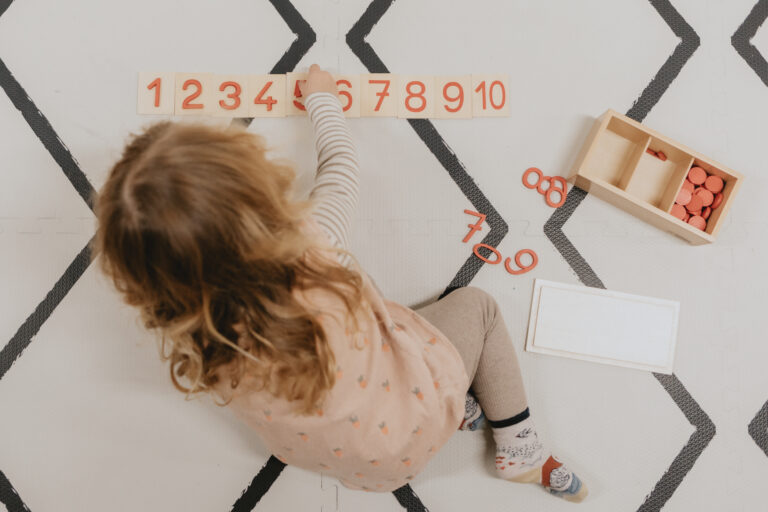
🌟 What makes Montessori materials special?
Montessori materials are different from anything you’ll find in a traditional classroom. They’re:
- Hands-on, encouraging movement, touch, and manipulation;
- Self-correcting, so the child learns to reflect and adjust without needing adult approval;
- Isolated in concept, focusing on one skill or idea at a time;
- Beautifully made, inviting respect, attention, and care.
Children don’t just memorize — they discover. They build abstract knowledge from real, concrete experiences. Isn’t that how deep, lasting understanding begins?
🧱 Pink tower, bead chains, and the movable alphabet
In the preschool years, you might see a child stacking a set of pink cubes, each slightly smaller than the last. This is the pink tower — and it’s not just about building. It strengthens visual discrimination, fine motor control, and an inner sense of order. It’s also an indirect preparation for math and geometry.
Next to it, another child might be unrolling a mat with long colorful strands of beads. These are bead chains, used to teach counting, squaring, and even cubing by touch, by movement, and by joy. Numbers become something a child can hold in their hands.
Nearby, a third child sits with the movable alphabet, arranging letters into words even before they’ve mastered writing by hand. It’s one of the most empowering materials in the Montessori classroom, allowing thoughts to become visible.
And in the culture area? A puzzle map of the world invites a young explorer to learn geography by removing, placing, and naming each country. Geography isn’t abstract — it’s tactile, sensory, and global.
These materials may seem simple. But they are deeply sophisticated in how they meet the child’s mind, not with information to absorb, but with tools to build understanding.
✋ The purpose behind the materials
Each material in the Montessori classroom setup serves multiple developmental purposes.
- It refines fine motor skills, as children grasp, sort, and balance objects with growing precision;
- It fosters independence because children can choose, use, and clean up each item on their own;
- It supports abstract thinking by helping children internalize concepts like quantity, language, geography, and more, all through experience.
Children learn not because they’re told, but because they’re engaged. They don’t need stickers or rewards — they have something much better: the satisfaction of discovery.
📚 Want to explore materials by subject?
Montessori materials touch every area of learning. Curious to dive deeper into how they’re used? Here’s a collection of in-depth articles to help you explore the Montessori method across different subjects:
- Language & Literacy: Montessori Method of Teaching Reading and Writing. Discover how language is introduced through phonics, movement, and storytelling.
- Mathematics: Montessori Math Explained. Learn how math becomes tangible and joyful — not just a subject, but a mindset.
- Technology & Logic: Coding for Children the Montessori Way. Explore screen-free ways to introduce logic, sequencing, and early coding.
- Science: The Montessori Way to Science. See how nature, experiments, and wonder fuel curiosity and scientific thinking.
- Art: Montessori Art Guide. Find out how creativity is supported through freedom, materials, and observation.
- Music: The Power of Music in Montessori Education. Understand how rhythm, tone, and sound develop not just musical skills, but the whole child.
Montessori materials do more than teach — they transform. They create moments of clarity, of “I did it myself,” of “I understand.”
And when you watch a child make those discoveries on their own, you’ll know exactly why these materials matter.
Multi-age groups: How they work and why they’re essential for Montessori classrooms
Multi-age groups are another essential characteristic of a Montessori classroom. Imagine a place where your child isn’t limited to sitting next to kids born in the exact same year. Instead, they learn side by side with younger and older peers — teaching, helping, observing, and growing at their own rhythm.
That’s the beauty of the Montessori classroom setup — and it’s one of the most defining (and misunderstood!) features. But how exactly does it work? And why is it so powerful?
🌈 The basics: Mixed-age groupings by design
Montessori classrooms are intentionally structured in multi-year age groupings, such as:
- 1–3 years in the toddler group;
- 3–6 years in the Montessori preschool classroom;
- 6–9 years in lower elementary;
- 9–12 years in upper elementary.
At first glance, this might seem unconventional. But it’s deeply rooted in Dr. Maria Montessori’s understanding of child development.
Children don’t grow in a straight line. They develop in cycles, and each cycle includes phases of rapid learning, consolidation, and leadership. Multi-age classrooms embrace this natural rhythm instead of fighting it.
🧠 Personalized learning without pressure
In a traditional classroom, every child is expected to move through the same lessons, at the same time, in the same way. But in a Montessori environment, learning is personalized, and multi-age classrooms make this possible.
Younger children look up to older classmates. They learn by watching, imitating, and receiving gentle peer guidance. Older children reinforce their own knowledge by helping others, becoming role models in the process.
There’s no pressure to “keep up,” and no shame in reviewing a concept. There’s only growth, exploration, and mutual respect.
This structure allows each child to follow their unique timeline, not the clock.
🌱 Leadership, empathy, and social growth in every Montessori classroom
Beyond academics, multi-age classrooms are rich soil for emotional development. Here, children get to practice:
- Leading without dominating;
- Helping without judging;
- Accepting help without embarrassment.
When a five-year-old teaches a three-year-old how to pour water or an eight-year-old patiently explains how to use the bead frame, they’re not just sharing knowledge. They’re developing confidence, compassion, and communication skills that last a lifetime. This dynamic builds community, not competition.
🤝 Stability, connection, and belonging in the Montessori environment
Children typically stay in the same Montessori school classroom for three years, forming strong relationships with peers and guides. This continuity builds trust and allows teachers to deeply understand each child’s strengths, needs, and learning style.
No yearly classroom shuffle. No “starting from scratch.” Just deeper connections, greater stability, and a learning environment that grows with your child.
Can you imagine the confidence that comes from being known, seen, and supported year after year?
As you can now see, multi-age classrooms aren’t a compromise — they’re a gift. In the Montessori model, they reflect real life, where we all learn from those ahead of us and share what we know with those behind.
And in that shared space of learning and leading, children grow into capable, kind, and curious human beings.
Differences between Montessori toddler, preschool, and school-age classrooms
As we’ve already mentioned, even mixed-age groupings have their division. Have you ever wondered how the Montessori method adapts as children grow? Is the Montessori toddler classroom just a mini version of what older kids experience, or does each age group bring something entirely new?
The answer is: The Montessori classroom evolves with your child.
While the core philosophy stays the same — trust the child, follow their development, prepare the environment — the classroom setup, materials, and daily rhythm shift meaningfully as children move from toddlerhood to preschool and into the elementary years.
Toddler, preschool, and elementary classroom comparison table
Here’s a side-by-side comparison to show how the magic unfolds at every stage:
| Category | Toddler Montessori Classroom (Ages 1–3) | Preschool Montessori Classroom (Ages 3–6) | Elementary Montessori Classroom (Ages 6–12) |
| Focus | Routines, self-care, gross motor skills | Sensorial learning, independence, early academics | Abstract thinking, collaboration, research |
| Environment | Calm, safe, soft materials, limited choices | Rich with Montessori materials across 5 core areas | Designed for movement, group work, and long-term projects |
| Key Materials | Pitchers, dressing frames, puzzles, stacking toys | Pink Tower, sandpaper letters, bead chains, geography puzzles | Timeline of life, grammar symbols, research folders, science materials |
| Social Development | Parallel play, beginning of empathy and cooperation | Group play, grace & courtesy lessons, early community responsibility | Collaborative projects, classroom roles, conflict resolution |
| Learning Style | Exploratory and physical, repetition through routine | Choice-driven, hands-on, self-correcting | Self-directed inquiry, big questions, group discussion |
| Teacher’s Role | Nurturer and modeler of care, calm presence | Observer, guide, introducing new materials as child is ready | Mentor, facilitator, offering support and freedom |
Gradual move between age groups
In the toddler Montessori classroom, everything begins with love and order. Children aged 1 to 3 are just starting to understand the world and themselves. The classroom design to supports routines — washing hands, putting on shoes, pouring water — and these everyday tasks are where confidence is built. Here, independence starts with small but mighty moments.
As children grow into the preschool Montessori classroom (ages 3 to 6), the world opens up. Sensory materials spark curiosity, and foundational academic concepts take root. Children don’t learn math, language, and geography with textbooks — they feel, move, trace, and experience. It’s a time of joyful repetition and growing responsibility.
Then, something shifts again around age 6. Welcome to Montessori elementary — a classroom full of big questions, long conversations, and collaborative discovery. Children want to know where humans came from, why volcanoes erupt, how numbers behave, and how society works. Here, research projects, field studies, and cosmic education take center stage. The classroom expands with the child’s imagination.
Isn’t it incredible to see how Montessori doesn’t force a child into a mold — it grows with them, gently revealing what they’re ready to learn, exactly when they’re ready to learn it?
Each stage builds on the last. Each prepares for the next. And throughout it all, your child gets the necessary trust, support, and freedom to flourish.
Final words: Why Montessori classrooms are for lifelong learning
What makes a Montessori classroom more than just a place to learn?
It’s the way the space itself is built with love and intention. The soft light. The low shelves. The hands-on materials. The quiet hum of children deeply immersed in work they chose for themselves.
It’s the rhythm — calm and purposeful — that allows a child to grow in confidence, not competition.
And above all, it’s the philosophy: that children are capable, curious, and full of potential. That with the right environment and gentle guidance, they can lead their own learning journey, not just for a year, but for life.
Montessori classrooms are built around trust!
Trust that a toddler can water a plant and feel proud. A five-year-old can sound out a word without any command. An eight-year-old can research ancient Egypt because it is interesting. That a twelve-year-old can debate ethics, build models, write reports, and still want to know more.
That’s the power of the Montessori classroom. It doesn’t just prepare children for school — it prepares them for life.
So if you’re wondering whether this kind of learning space could be right for your child, ask yourself:
🌱 Do I want my child to feel safe, seen, and inspired every day?
🌍 Do I believe learning should be joyful, not rushed?
🧠 Do I want my child to be an independent thinker, not just a good test-taker?
If so, we invite you to explore a Montessori classroom for yourself.
Come visit us at the Montessori Family Center, and see firsthand what makes this environment so special. You’ll step into a space that doesn’t just teach — it transforms.
Because learning isn’t about filling up a child with facts. It’s about giving them the space, tools, and trust to discover the world — and themselves.
And that journey? It starts right here. 💛
Frequently asked questions about Montessori classrooms
1. What is a Montessori classroom?
A Montessori classroom is a carefully prepared learning environment designed to support independence, exploration, and self-directed activity. It includes hands-on materials, child-sized furniture, and mixed-age groupings that reflect Montessori’s developmental approach.
2. How is a Montessori classroom different from a traditional classroom?
Unlike traditional classrooms, Montessori spaces are calm, open, and organized around the child. There are no rows of desks or teacher-centered lessons — instead, children move freely and choose their work based on interest and readiness.
3. What age groups are included in a Montessori toddler classroom?
A Montessori toddler classroom typically serves children aged 1 to 3. These classrooms focus on routines, self-care, sensory exploration, and developing independence through practical life activities.
4. What happens in a preschool Montessori classroom?
The Montessori preschool classroom (ages 3 to 6) introduces sensorial learning, early math and language, and cultural studies using tactile, self-correcting materials. Children develop focus, responsibility, and a deep love of learning.
5. Why does the Montessori method use mixed-age classrooms?
Mixed-age classrooms allow younger children to learn from older peers while older children strengthen leadership and empathy skills by helping others. This model supports natural learning cycles and community-building.
6. What are Montessori classroom materials, and how do they work?
Montessori materials are hands-on learning tools designed to isolate specific concepts and allow for self-correction. Examples include the Pink Tower for size discrimination, bead chains for counting, and movable alphabets for language development.
7. How does a Montessori classroom promote independence?
Every aspect of the Montessori classroom setup — from child-sized furniture to accessible shelves — encourages children to make choices, care for materials, and work without constant adult intervention, building confidence and self-discipline.
8. Is there a Montessori approach to teaching subjects like science and art?
Yes! Montessori integrates subjects like science, art, music, and geography into the daily routine. Children learn through observation, exploration, and hands-on discovery rather than textbooks and lectures.
9. What role does the Montessori teacher play in the classroom?
In Montessori, the teacher is a guide, not a lecturer. They observe each child closely, offer lessons individually or in small groups, and introduce new materials when the child shows readiness and interest.
10. Can children transition from a Montessori classroom to a traditional school?
Absolutely. Montessori-educated children often adapt well to new environments because they are confident, independent, and skilled at problem-solving. Their strong foundation in self-directed learning serves them across any educational setting.
References and further reading
- What Makes the Difference – Guidepost Montessori: A parent-focused guide that breaks down what sets a Montessori classroom apart, including how layout and materials foster focus, independence, and joy.
- Montessori Education – Wikipedia: A comprehensive reference article detailing the origins, core philosophy, methods, and global reach of Montessori education.
- Inside the Elementary Classroom – American Montessori Society (AMS): An in-depth look at Montessori’s elementary-level approach, featuring key themes like research, collaboration, and cosmic education.
- Prepared Environment – Montessori Academy Australia: Explains how the Montessori classroom setup promotes independence, order, and freedom within limits.
- The 5 Areas of the Classroom – Richmont Montessori: A breakdown of the core classroom areas — Practical Life, Sensorial, Math, Language, and Culture — and how each one supports child development.
- About Montessori Education – Montessori Northwest: A clear and accessible introduction to Montessori theory and classroom structure, including how teachers guide learning through observation and choice.
- Montessori Curriculum – Montessori.com: A summary of how to apply Montessori principles to different subject areas and how to use materials to support hands-on learning.
- The Prepared Environment – University of Connecticut Libraries: A thoughtful explanation of the prepared environment concept, emphasizing the role of design in enabling child-centered learning.
- Multi-Age Groups – Guidepost Montessori: Highlights why mixed-age classrooms are a core part of Montessori education, showing how they support mentorship, leadership, and deeper social-emotional growth.